

Restaurant supplier price comparison: put the offers on the same unit before you look at price
Restaurant supplier price comparison: put the offers on the same unit before you look at price
In short
- Three offers for the same product, when the pack sizes differ, usually don't measure the same thing: one is the price of a case, one of a kilo, one of a carton with VAT folded in.
- Five differences distort the comparison and none has its own column on the price list: selling unit, VAT, delivery, net weight versus drained weight, and minimum order plus the date of the list.
- The number that matters is the price per unit of use, meaning the kilo that actually reaches your kitchen, not the kilo printed on the label.
- In this article's invented example, the supplier that looks cheapest on the list turns out to be the most expensive after the corrections. The sums are below, so you can redo them with your own figures.
- The lowest normalized price is where the decision starts, not the decision: product equivalence, terms and reliability still have to be checked.
Three price lists, three numbers that aren't the same thing
Comparing supplier prices by reading price lists side by side gives the wrong comparison whenever the pack sizes differ, because the three figures in the column don't measure the same quantity. The price that decides is the price per unit of use: the usable net kilo, or the portion that lands on the plate.
Here is a common case. You want a second supplier for canned tomatoes, so you ask three for a quote. The first sends a PDF with a case of six cans. The second answers on WhatsApp with a price per kilo. The third attaches a list priced by the carton, with an asterisk next to the VAT line. You end up with three figures with decimals, all starting with a currency symbol, and the temptation to rank them from lowest to highest.
The trouble is the pack size, which decides what sits behind each number. The case price covers six cans, the pail price covers one container, and the carton price covers four cans of a different size. Even a price "per kilo" can refer to net weight, drained weight, or gross weight with the packaging. The list that is easiest to read wins the comparison for reasons that have nothing to do with value: it's the one you had to do the least arithmetic on.
How many suppliers to keep is a separate question, and we covered it in how many restaurant suppliers is too many. This piece starts from the case where one product already has more than one offer on the table, because you asked for a second one or because your usual supplier raised the last price list. Before you decide who to order from, the offers have to sit on the same unit, and there are five differences to correct.
Where the comparison breaks: five differences the price list never puts in a column
A supplier comparison breaks on five differences that no price list gives its own column, and each one is a question you can put to the supplier in writing before you look at the price.

Pack size and selling unit
Price per case, price per kilo and price per piece are three different quantities, and comparing them as if they were the same is an easy mistake. A case of six 2.5 kg cans holds 15 kilos; a 25 kg sack holds 25; a 5 kg tub holds 5. A lower price per case can hide a smaller case. The question to ask: how many net kilos are in one pack, and what does one kilo cost?
VAT excluded or included
VAT has to be brought to the same basis for everyone, because some suppliers quote with the tax included and others without, often without saying so. If you recover the tax, the right comparison is on the price before VAT or sales tax; if you're unsure about your own situation, ask your accountant. Watch the rates too: not every product carries the same one, and a line on a price list with the wrong rate moves the sum.
Delivery and who pays the freight
Delivery is a fixed cost per drop, so it weighs more on the kilos of a small order than on a large one. "Delivered" means freight is included in the price; "ex-warehouse" means you pay for transport, either as a separate line or by collecting the goods yourself. To know what you really spend per kilo, pick a reference order, the one you place in a normal week, and divide everything the supplier charges you by its kilos.
Net weight and drained weight
The kilo you pay for is not the kilo you serve. In canned goods, net weight includes the liquid in the can; drained weight is what stays in the colander, and it is what ends up in the sauce. Fresh produce that needs trimming follows the same logic under another name, usable yield: after the trim loss, the kilo you bought becomes a fraction of a kilo you can cook. Two products at the same price per net kilo can cost very different amounts per usable kilo.
Minimum order and the date of the list
A price can be correct and still not obtainable. If the supplier asks for a minimum order higher than what you use, you either buy more than you need or pay a surcharge, and in both cases the list price isn't what you'll pay. Then there's the date: the comparison only works if all the prices are from today, while the last price list one supplier sent may be from March and another's offer from yesterday. Ask everyone how long the price holds.
An example with invented numbers, to see the mechanism
The numbers in this section are invented, chosen so the sums work out in your head: they describe no real supplier and indicate no market price. They only show how the ranking of three canned-tomato offers changes when you bring them to the same unit, on a reference order of 60 net kilos (a convenient multiple of 15, 10 and 12).
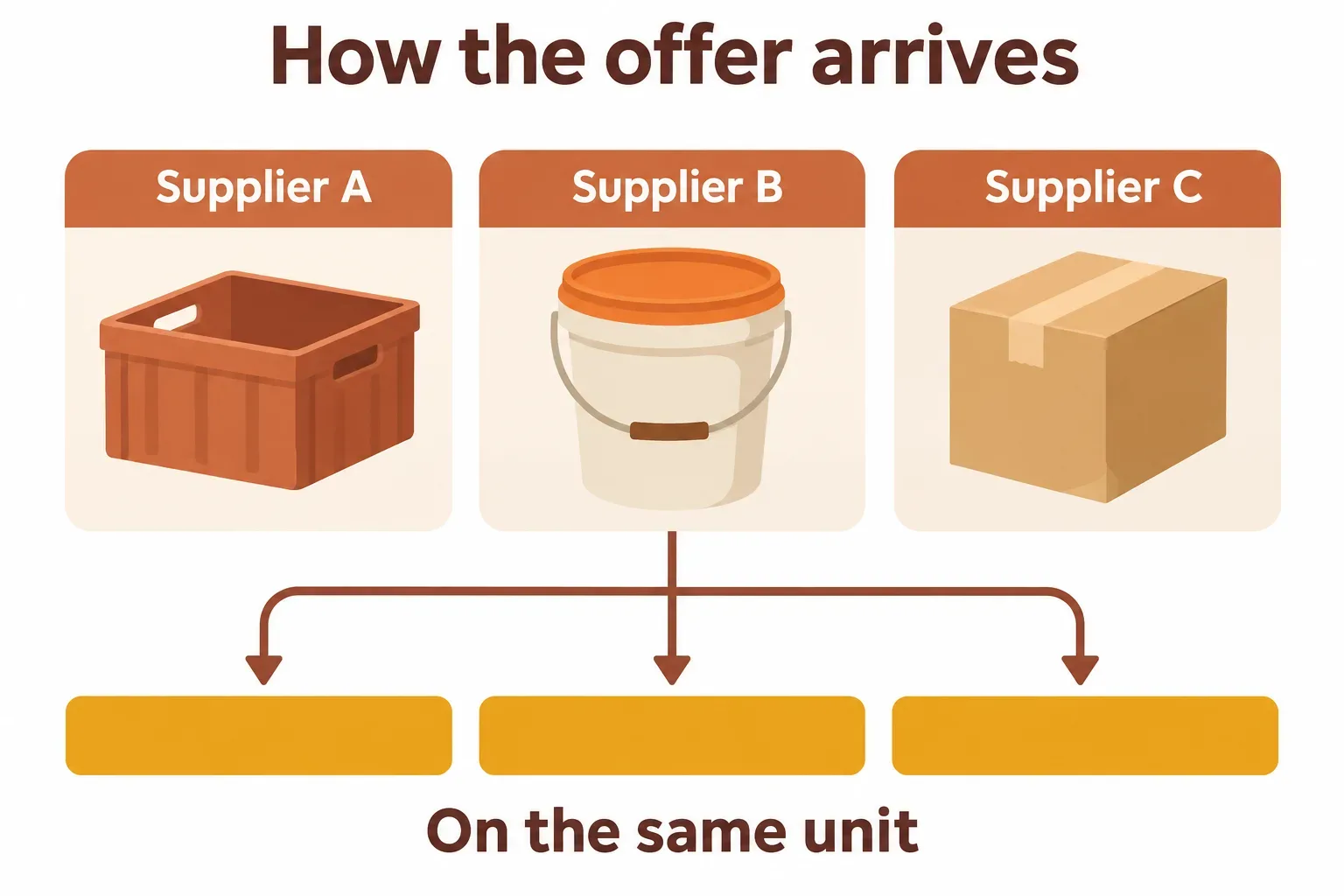
The three offers:
- Supplier A: case of 6 cans of 2.5 kg (15 kg net), 21.00 € per case before VAT, delivery included, drained weight equal to 60% of net.
- Supplier B: pails of 10 kg net, 1.20 € per net kilo before VAT, plus 18.00 € delivery per drop, drained weight equal to 55% of net.
- Supplier C: carton of 4 cans of 3 kg (12 kg net), 16.50 € per carton with VAT included (an assumed rate of 10%, also invented), delivery included, drained weight equal to 60% of net.
The reference order is 60 net kg: 4 cases from A, 6 pails from B, 5 cartons from C. Here is the cost per kilo after each correction (rounded to the cent):
| Offer | As read on the list (€/net kg) | Before VAT | With delivery | Per drained kilo |
|---|---|---|---|---|
| Supplier A | 1.40 | 1.40 | 1.40 | 2.33 |
| Supplier B | 1.20 | 1.20 | 1.50 | 2.73 |
| Supplier C | 1.38 | 1.25 | 1.25 | 2.08 |
The sums, for anyone who wants to redo them. A: 21.00 € ÷ 15 kg = 1.40 €/kg; on the order, 4 × 21.00 = 84.00 €, drained 60 × 0.60 = 36 kg, 84.00 ÷ 36 = 2.33 €/kg. B: 1.20 €/kg; on the order, 60 × 1.20 = 72.00 € plus 18.00 € delivery = 90.00 €, which is 1.50 €/kg; drained 60 × 0.55 = 33 kg, 90.00 ÷ 33 = 2.73 €/kg. C: 16.50 € ÷ 12 kg = 1.375 €/kg with VAT; without it, 16.50 ÷ 1.10 = 15.00 € per carton, 15.00 ÷ 12 = 1.25 €/kg; on the order, 5 × 15.00 = 75.00 €, drained 36 kg, 75.00 ÷ 36 = 2.08 €/kg.
Read the left column and B is the lowest. Take out the VAT and C closes in without catching it. Add delivery and B climbs to 1.50 while C stays at 1.25: the ranking has already changed. Move to drained weight and B, which started first, finishes last. No supplier touched a price. What changed is the quantity you were looking at.
With other numbers the ranking might have stayed as it started. The example doesn't say price lists are always wrong; it says you can't tell from the price list whether they are.
The method: bring everything to the same unit, in five steps
Bringing several offers to the same unit of use takes five corrections, always made in the same order; the first four change the number, and the last one tells you whether you can actually get it. You do the work once per product and redo it only when the pack size or terms change.
- Reduce everything to the net kilo. Divide the pack price by the net kilos it contains. Ask the supplier for net kilos per pack, not "a case of six".
- Put everyone on the same VAT basis. If a price includes VAT, divide it by one plus the rate (1.10 for 10%). Check the rate product by product.
- Add delivery. Choose the reference order you really place, add up the delivery charges and divide the total by the order's kilos.
- Move to usable weight. For products in liquid, ask for the drained weight and divide the cost by it. For products that need trimming, weigh a case before and after trimming, once, and work out your own yield.
- Check minimum order, date and payment. These don't change the price per kilo, but they can make it unobtainable: a minimum above your usage, an old price list, payment in advance.
To save yourself the back-and-forth, send every supplier the same request with the same seven questions: net kilos per pack, drained weight, VAT included or excluded, delivery cost, minimum order, how long the price holds, payment terms. The answers come back in the same shape, and a sheet with one row per supplier and one column per correction fills in within minutes.
When the lowest price is not the right answer
The lowest normalized price is the starting point for choosing a supplier, not the choice itself: first you need to know whether the products are identical or only equivalent, and on what terms you can get them.
An identical product is the same item, same brand and same size; an equivalent one does the same job in the kitchen but may come from somewhere else, have a different colour, a different yield. If two tins of tomatoes cost different amounts per drained kilo, the difference may lie entirely in how they behave when cooked. Try the equivalent in your kitchen before you switch, with a small order.
Payment terms don't touch the price but they do touch your cash: paying at thirty or sixty days moves the moment the money leaves. And then there's reliability. A supplier who quietly delivers half a case short, or skips Tuesdays, has a real price higher than the one you calculated. Those real terms only show up by ordering and receiving, which is one of the reasons supplier records and orders are the same job: today's comparison goes stale, the delivery history doesn't.
What to ask of a tool that does this for you
A tool that helps you compare suppliers has to keep, for each product, the unit of use and the price per that unit, not just the price of the pack. Three questions to put to it in a demo:
- Can I record the net kilos per pack and see the price per kilo, not only per pack?
- Do I see the price I actually paid at delivery, or only the one that was on the price list?
- If a supplier changes pack size, does the tool notice, or do I find out from the invoice?
On mayo, the part that touches this work is price-variation analysis: it's on the Pro plan, it's used from desktop, and it shows how the prices of the products you've bought have moved over time. It isn't an alert system and it doesn't measure how much you save, and it doesn't replace the five-step calculation, because it starts from what you have already bought. Checking prices and deliveries when the goods arrive is covered on the page about checking prices and deliveries at goods receipt.
After the choice, the comparison that matters changes: it becomes price paid against the latest price list, which we described in how paid prices compare with the price list, and it is one of the three numbers to look at every Monday.
The next time a supplier sends you a price list, reply with the seven questions first and leave the totals for later. Whoever answers precisely is already telling you how they work; whoever sends back another PDF is telling you too.
Keep your spending under control with mayo
Up-to-date price lists, centralized orders and prices verified on every delivery. Try it with your team.
Keep reading

Restaurant Supplier Management Is the Same Job as Order Management
Why keeping your supplier records and your order flow in two different tools adds work instead of removing it, and what to ask of a tool that holds them together.

How many suppliers is too many for your restaurant
The number of suppliers you carry is a cost line nobody negotiates. Here is how to work out, from your own purchasing data, when one more stops paying for itself.