

How many suppliers is too many for your restaurant
Before you choose a supplier, count the ones you already have
Choosing a supplier is a problem you already know how to solve. You look at the price, you look at the quality of the goods, you look at whether the van turns up when it said it would, and after two months you know whether you can rely on them. What almost nobody puts on the balance sheet is how many suppliers you are carrying at the same time. That number appears in no negotiation and on no price list, which is exactly why it grows on its own: a supplier comes in because you needed that one product that one week, and then they stay.
Try to picture how many different names have delivered something to your back door in the last twelve months. Not how many you use every week — how many have raised at least one invoice. In most kitchens the second number is a great deal bigger than the first, and the gap is made up of suppliers who came in for a reason that may no longer exist. The fishmonger you used for one Christmas menu. The craft brewery you replaced two summers ago and never quite closed off. The chemicals supplier you keep for a single degreaser, who drops twice a year.
That twice-a-year supplier feels like it costs you nothing, because the cost you attribute to them is the price of what you buy. But the price you negotiate and the cost of running the relationship are two different things. You negotiate the first. You pay the second in your own hours and in mistakes: another account to maintain, another invoice that still has to be opened, checked, coded and paid at month end, another contact who expects an answer. Every supplier has a share of your spend — how much of your total purchasing they account for — and a share of your workload, which has almost nothing to do with the first. When the second is bigger than the first, that supplier is costing you money.
What one more supplier actually costs you
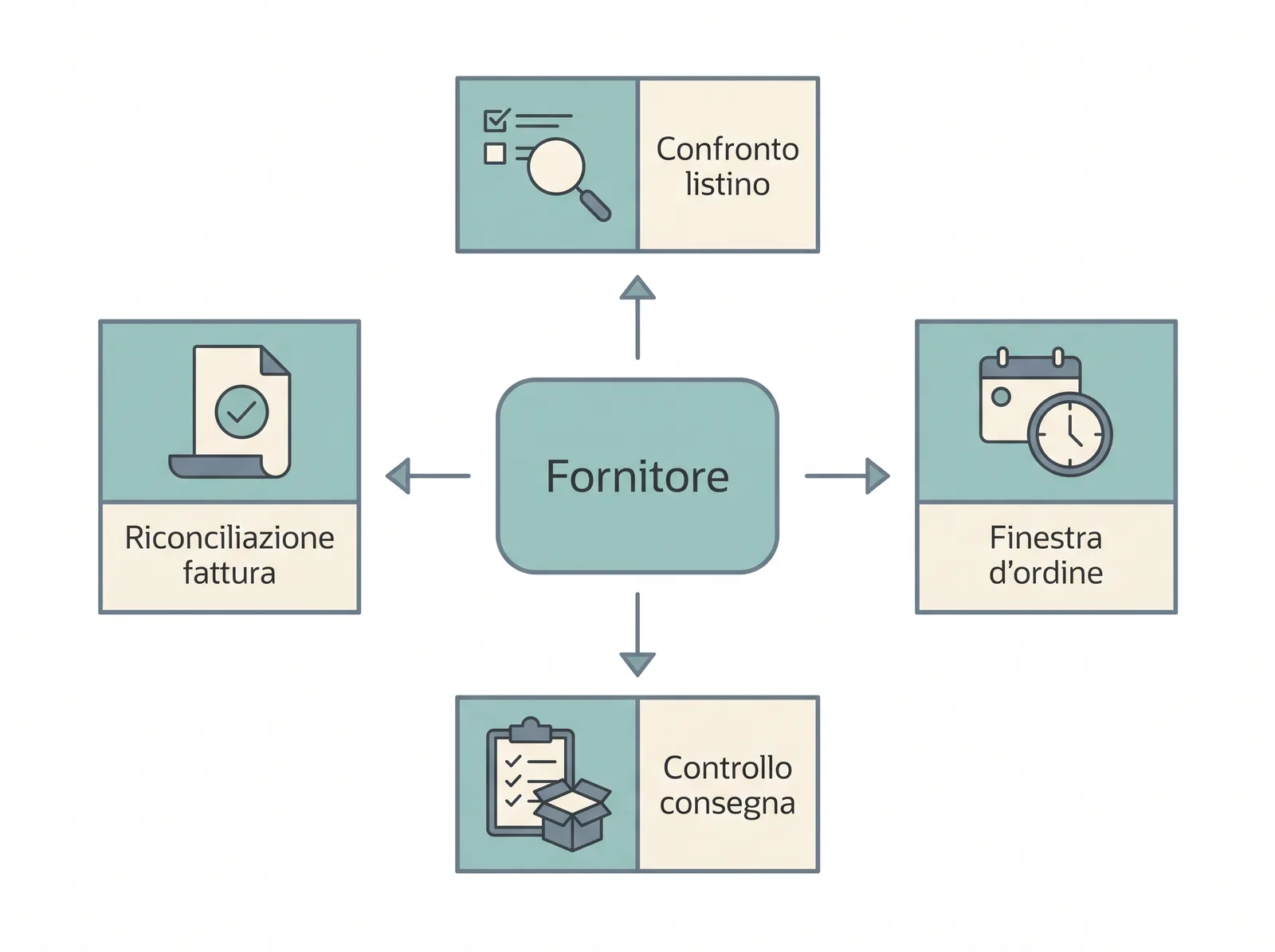
Every supplier adds four recurring jobs that nobody puts a clock on: a price list to compare and keep current, an order cut-off and a delivery day to work around, a delivery to check at goods-in, and an invoice to reconcile against that delivery. They are recurring by definition. You do not pay them once when the supplier is onboarded — you pay them every week for as long as that name stays on the list.
The price list. A price list on its own is useless; it only does anything when it is compared. And the comparison has to be redone every time either side moves, which on fruit and veg means more or less constantly. With a handful of suppliers you know off the top of your head who is sharpest on what. Past a certain number you stop knowing, and you start ordering out of habit — which is precisely the moment competition between your suppliers stops working in your favour.
The cut-off. Each supplier has a time by which the order has to be in for the agreed delivery day, and no two of them line up. With four suppliers the week has a rhythm you hold in your head. With twelve you have a grid, and a grid that lives only in someone's head eventually drops a line. The Tuesday cut-off you miss is not an admin annoyance; it is Friday night short, with a dish pulled off the menu or a trip to the cash and carry at full retail.
The delivery. Checking at goods-in means confirming that what arrived is what you ordered, in the quantities you ordered and in the condition it was supposed to arrive in. It is the check that goes first when the drop lands mid-prep, and it is the one that makes all the others pointless: sign the delivery note without reading it and you have just given away the only evidence you had. No signed discrepancy, no credit note.
The invoice. This is where the loop closes, or doesn't. Reconciling invoice against delivery means putting what turned up next to what you are being charged for, line by line, price by price. It is where you find the prices that moved without anyone telling you — the item you have bought for years that costs a bit more this month. A price increase is perfectly legitimate. What is not legitimate is finding out about it three months later, if you find out at all.
On top of those four sit the constraints that bend your ordering out of shape. Every supplier's minimum order value and carriage-paid threshold push you to buy more than you need so you don't pay for delivery, and with a long supplier list you end up doing that on several fronts at once — a dry store full of stock bought to clear a threshold rather than to serve a menu.
The sum that tells you whether you've got too many
To work out whether you have too many suppliers you don't need a benchmark. You need the shape of your own spend. Anyone handing you a figure that holds for every restaurant is handing you a number arrived at without looking at your purchasing, and the right answer for a pizzeria buying across four categories is not the right answer for a seafood restaurant taking a daily fresh drop. The real sum has three steps, and you can do it from a year's worth of purchase invoices.
One: rank your suppliers by share of annual spend. Take your total purchases for the year and, for each supplier, what they accounted for. Sort high to low. This is the only step that needs a spreadsheet, and it takes about five minutes.
Two: look at the tail. At the top you will find the few names most of your money goes to, and they are not the problem — you know them, you negotiate with them, you watch them. The problem is the long tail at the bottom: suppliers worth a few hundred pounds a year who still occupy a full seat in your working week. Read the tail in absolute money as well as percentage. A one per cent share tells you nothing on its own, whereas "three hundred quid a year and two invoices a month" tells you everything.
Three: one question per supplier in the tail. What do they cover that nobody else covers? There are three possible answers.
- Nothing the others don't already cover. These are your consolidation candidates: buy that line from a supplier who is already delivering to you, even if the unit price is a little worse. You are weighing that price difference against four fewer recurring jobs a week, not against nothing.
- A specific product nobody else has, and you genuinely need it. It stays. But it is worth asking your bigger suppliers whether they carry it, or could. A monopoly is often just a habit that nobody has tested.
- A specific product nobody else has, which barely matters on the menu. Here the question changes, and it is the uncomfortable one: is that dish worth the supplier it costs you? Sometimes yes. Sometimes you sell it three times a month.
The sum doesn't end with a number you can pin above the desk. It ends with a short list of suppliers you have made a deliberate decision about, which is a different and more useful thing.
Comparing prices without comparing apples with oranges
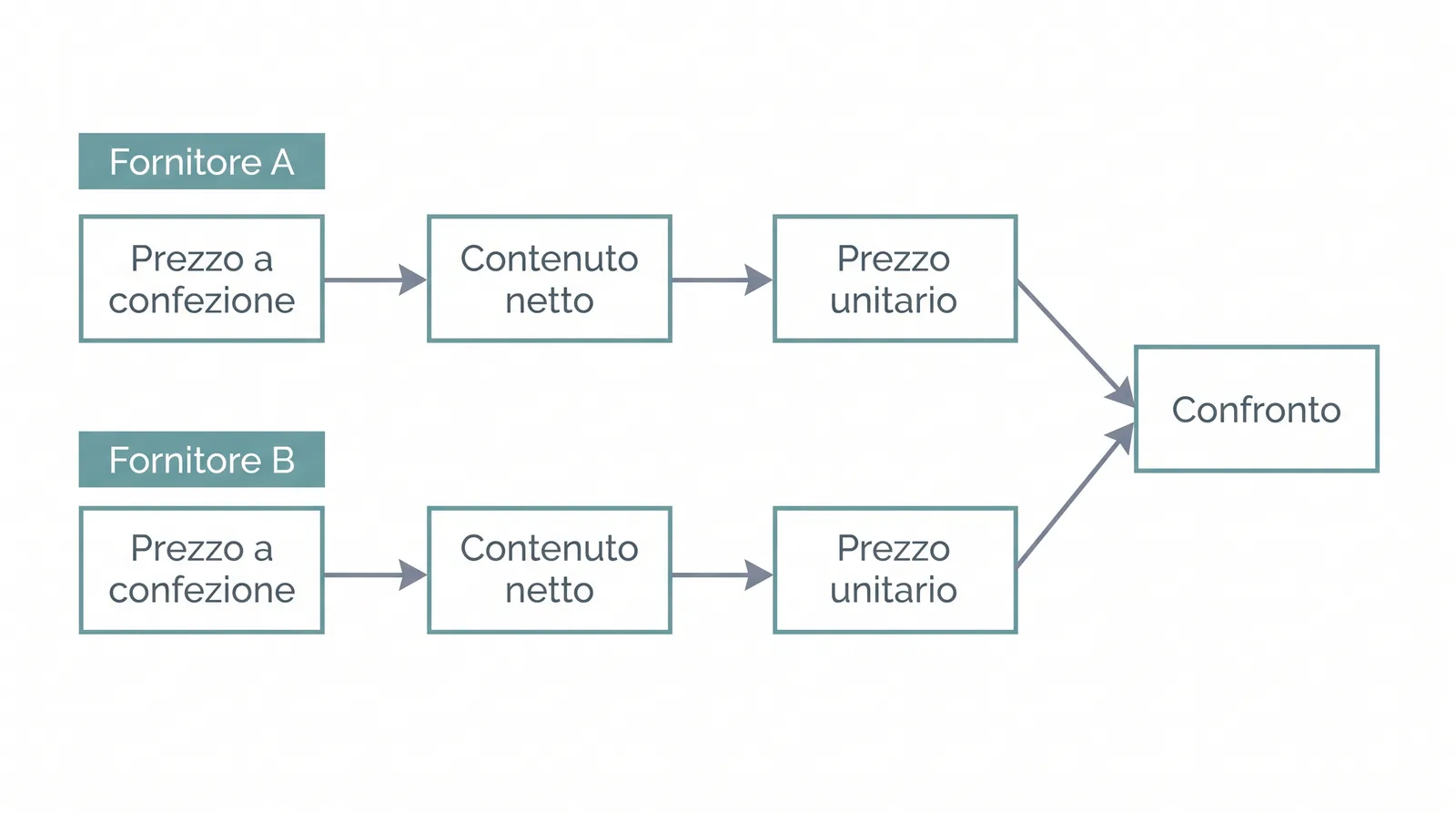
A comparison between suppliers only holds at a comparable unit of measure: per kilo, per litre, per portion. A case price cannot be compared until you bring it back to that unit, because two suppliers' pack sizes almost never match — and that is where the comparison quietly breaks, before you have decided anything at all.
Normalising is trivial and has to be done anyway, every time: take the case price, divide by the net content of the case, and you have a unit price. Only then are the two figures on the same scale and the question "who is cheaper" has an answer. The people selling to you know this perfectly well, and non-standard pack sizes are rarely an accident: the tin in an unusual size, the case whose drained weight is not the net weight on the label, the crate whose stated weight includes the packaging.
On fruit and veg there is a second step, and it matters more than the first: yield. You pay on the weight that comes through the door and you cost on the weight that reaches the plate. Two suppliers at the same price per kilo with different yields are selling you two different products at two different prices, and the one that looks dearer is often the cheaper one. If you have a feeling that one greengrocer "goes further", weigh the trim once instead of trusting the feeling. Half an hour of somebody's time covers you for the whole season.
Then there is time. Fresh prices move with the season, so a comparison that is true today can be false in two months without anyone having done anything wrong. That is not a reason to skip the exercise. It is a reason to date the comparison and redo it when the season turns, instead of treating a choice made in September as settled.
When an extra supplier is the right call
On the ingredient that stops service if it doesn't arrive, a second supplier is insurance rather than duplication, and it should be judged as insurance. Cutting the supplier list is a sensible objective right up to the point where it touches something that closes the kitchen — and that point has to be identified in advance, not discovered on a Friday in August.

You identify a critical supplier with the menu test, not the spend test. It is not the supplier you spend most with; it is the one whose missed delivery takes something off the menu that you cannot be without. In a pizzeria that is flour and mozzarella, and it isn't close. In a seafood restaurant it can be a single merchant handling the daily fresh drop, who may sit well down the annual spend ranking but without whom, tomorrow night, you are serving half a menu.
On those two or three lines — and there are only ever a few, so count them — keep the second supplier. But keeping means something specific. A backup who exists only in your contacts is not a backup. It is a phone number that discovers, on the day you need it, that your account details are two years out of date, that they aren't on your round that day, that there is a minimum order value you can't reach and a price list nobody has looked at since. You keep a second supplier alive with real orders, small and regular. Those orders are the insurance premium, and they belong in the sum alongside everything else you buy from them.
What the premium is worth is decided against the cost of the outage. Take an evening service without your best-selling dish: you can estimate that yourself, because you know your covers and you know what that dish contributes. Once you've done that sum, "do I keep a second flour supplier" stops being a matter of opinion.
Where to get the numbers if you haven't got them today
If your ordering lives on WhatsApp, on the phone and on a pad hanging by the pass, the data for this exercise already exists but isn't queryable — which is a technical way of saying it is there and it is no use to you. What separates a restaurant that knows what each supplier weighs from one that goes on instinct is rarely the software. It is that somebody, at some point, started writing the orders down in the same place every time.
The practical minimum is three fields per order line: supplier, quantity, unit price. You always have the first. You nearly always have the second. The third is the one that goes missing, because on the phone you order "two boxes of plum tomatoes" and you find out the price when the invoice lands. That field is what makes everything else possible: without a unit price captured at the point of ordering you cannot spot a price that moved, you cannot normalise a comparison, and you cannot rebuild share of spend without waiting on the bookkeeper.
Give it a quarter. That is the shortest window that shows you something other than noise: it takes in the fresh price swings, at least one price list revision, and enough deliveries for the reliable and the unreliable to separate themselves. Anything shorter and you are reading last week.
There are three routes, and all three work as long as the choice sticks. A shared spreadsheet genuinely does the job, provided one named person owns filling it in and does it on the day of the order rather than at month end. The EPOS or back-office system you already pay for often captures purchases better than you think, and it is worth asking before you buy anything else. A procurement platform — mayo, which we build, is one of them — keeps the order, the unit price and the delivery inside the same flow, which is the most direct way of not ending up with that third field empty. But if your problem today is that nothing is being recorded at all, Monday's spreadsheet beats next month's platform.
Whichever route you take, the first sum you run at the end of the quarter won't tell you how many suppliers you ought to have. It will tell you which of the ones you have you are paying for twice: once on the price list and once in labour. That list is short, it usually surprises people, and from then on "which supplier do I choose" goes back to being the second question rather than the first.
Keep your spending under control with mayo
Up-to-date price lists, centralized orders and prices verified on every delivery. Try it with your team.
Keep reading

Restaurant Supplier Management Is the Same Job as Order Management
Why keeping your supplier records and your order flow in two different tools adds work instead of removing it, and what to ask of a tool that holds them together.