

Supplier order errors in a restaurant: you prevent them at delivery, not when you write the order
Supplier order errors in a restaurant: you prevent them at delivery, not when you write the order
In short
- A typo is the cheapest order error you can make, because you see it straight away. The ones that cost money are the gaps between ordered, delivered and invoiced, which usually nobody compares.
- Four gaps open at delivery: an unagreed substitution, a missing line, an extra line, a different pack size. One opens at the invoice, when you are billed for something that never arrived.
- You find them late because the order, the goods and the invoice are never in front of the same person at the same time. By month end, disputing is almost always impossible, or awkward.
- The check works at receiving, line by line, and only if you have a written reference, the order you sent, to compare the goods against.
- To survive seven o'clock in the morning, the check has to be short, within reach of whoever receives the goods (not always the person who ordered), and built around noting differences, not arguing about them.
A typo is the cheapest order error you can make
A mistake in writing the order costs little and is almost always recoverable, because it shows up immediately. You type 10 cases where you meant 1, the supplier calls you, or the delivery arrives and the pile on the floor does not match what is in your head. You send it back, correct it, and that is the end of it. Most guides to order errors spend their time on this kind of slip (incomplete details, a badly written quantity, vague requests), and their advice is nearly always the same: write the order better.
Writing the order better is good advice, and it does not fix the problem that costs you money. A perfect order can still be answered with different goods, and you will not notice until someone puts one next to the other. The typo is loud. The gap between what you asked for and what ended up in your storeroom is quiet, and the quiet is what makes it expensive.
From here on I am talking about the errors that make no noise. If you have ever searched for how to avoid mistakes in supplier orders, the answer of this article is that an order error is prevented when the goods are received, not when the order is written. The order still matters, but as a reference: it is the document you check against.
Where the costly errors come from: ordered, delivered, invoiced
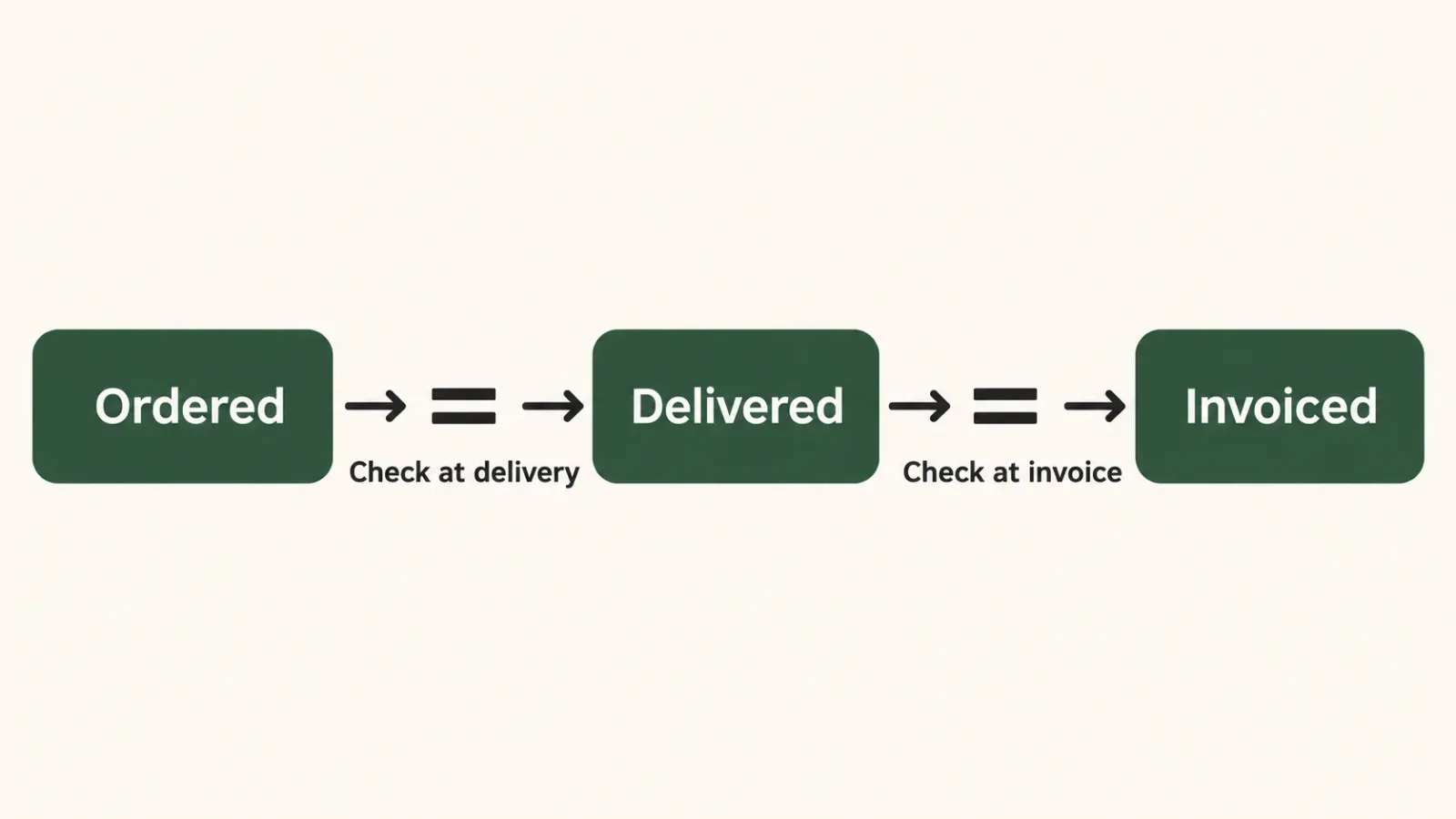
The order errors that cost money open up at two handovers, between ordered and delivered and between delivered and invoiced, and at each one something changes without anyone telling you. Three quantities are supposed to match: what you ordered, what arrived, and what you were invoiced for. When they do not, it is rarely bad faith. Far more often it is a warehouse picker who did their best with what was on the shelf.
Between ordered and delivered
Four different things can change at the door, and each has a name in kitchen practice.
- The unagreed substitution. You ordered one product and an "equivalent" turns up: another brand, another variety, another size. Sometimes it is the right call and sometimes it is not, and either way the decision was made by someone who does not cook in your kitchen. If you do not spot it, the supplier invoices it as if it were the product you ordered.
- The missing line. The product is not there and nobody said so. It is not an error until you find out, mid-service, that you are out; it becomes an expensive one if the line appears on the invoice anyway.
- The extra line. Something arrives that you did not order: a promotion, a product "you might need", a duplicate. You cannot reject it at a glance, because it might be a free item agreed over the phone. First you need to know which of the two it is.
- The different pack size. You ordered the case of six and the case of four arrives; the price per case looks the same, the price per kilo does not. We covered how much pack size distorts prices in restaurant supplier price comparison: put the offers on the same unit first. What matters here is that the pack size changes without your knowing. The same goes for variable-weight products: the order says a kilo and a half, and the supplier's scale put in one kilo two hundred.
Between delivered and invoiced
The second gap opens on paper. The delivery note that travels with the goods should say what was delivered, and the invoice should say the same. Should: in practice the invoice is often prepared by a different office, working from the order and not from the delivery. So it can carry the line that never arrived, the quantity you ordered instead of the quantity delivered, or a price different from the one you agreed.
This second handover is the most insidious, because by then the goods are gone: used, sold or thrown away. Your only evidence is a comparison that, if you did not make it at delivery, you can no longer make.
Why you find out late, and why you can't do anything about it by then
You find the gaps between ordered, delivered and invoiced late because the order, the goods and the invoice are never in front of the same person at the same moment; by the time the sums do not add up, the goods have been cooked and disputing costs more than you would recover.
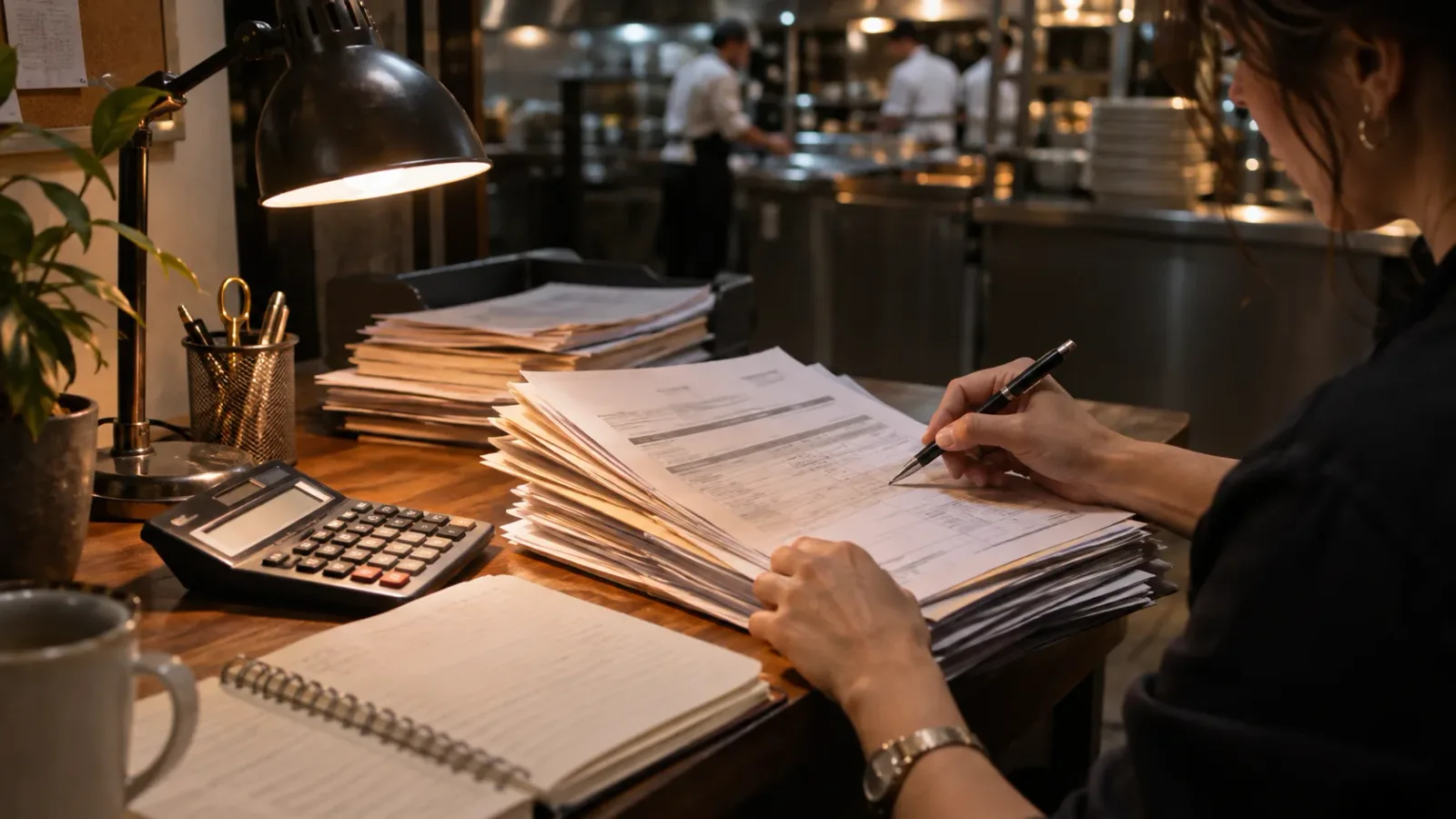
The person who orders, the person who receives and the person who pays are often three people, or the same person at three moments far apart. The chef writes the order on Thursday, a line cook receives the goods on Monday while prepping lunch, and the owner sees the invoice whenever it lands, sometimes days later, sometimes bundled at month end. At no single moment does any of them have the order you sent, the goods on the counter and the tax document together. The comparison does not fail through carelessness. It does not happen because nobody is in a position to make it.
Here is an example with invented numbers, only to show the scale of the problem. You order 20 kilos of zucchini at 2.50 euros a kilo. Sixteen arrive and nobody notices. The invoice says 20. Four kilos at 2.50 is ten euros: an amount nobody disputes and nobody remembers by month end. Multiply it by the deliveries in your week, by the suppliers you have, by the weighed products and the substitutions that change the price, and the "nothing" starts to have a total. The figure reflects no industry average; it only says that a small error, repeated, is not small.
Then there is the question of deadlines. How long you have to dispute a delivery that does not match depends on your contract with the supplier and on the rules that apply to your case, and this article cannot tell you more than that: ask your supplier and your accountant, and do it before you need to. What can be said is practical. The more time passes, the harder the dispute is to support ("you received it and used it"), and even when you win, the result is a credit note that arrives weeks later and that somebody has to remember to reconcile against the next payment.
The comparison that counts is the one you make while the goods are still on the counter. It is also why, among the three numbers to look at every Monday, the gap between ordered, delivered and invoiced comes third: looking at it on Monday tells you where you lost, but only the check at receiving lets you not lose it.
The check at receiving, line by line
The check at receiving means comparing every line of the order you sent with what is in front of you, before the driver leaves; it takes a few gestures, always in the same order.
- Open the order you sent, not the order you remember. You need the document that actually went to the supplier, with the lines, quantities and pack sizes you wrote. If your order is a spoken conversation, the first step is to turn it into something written.
- Go through the lines one at a time, not the goods. For each line ask three things: is it there, is the quantity right, is the pack size right. Starting from the goods ("let me see what came") makes you notice only what is present; starting from the lines brings out what is missing.
- Weigh whatever is bought by weight. If the line says two kilos of fish, the supplier's scale is not yours. Weighing takes half a minute, and it is the only way to know.
- Decide on the spot about substitutions and extra lines. You accept or refuse a substitution there and then; you accept an extra line knowing what it is, or you send it back. Do not pass the decision on to whoever "looks at the invoice": a decision gets made with the product in front of you.
- Write on the delivery note what you found. A missing line, a different quantity, an accepted substitution: put it on the delivery document before you sign. If you sign a delivery note "as received" without marking anything, even when there is a difference, it becomes much harder to argue afterwards that there was one. How a reservation should be written and what weight it carries depends on your agreement with the supplier, so settle that question in advance too.
- Keep the copy of the order with your corrections. The day the invoice arrives, the comparison is already done, and you only need to look at the lines you marked.
The check does not require experience; it requires discipline. Every step is trivial, and the risk is skipping all of them on the same day the van is late and service is about to start.
What it takes for the check to hold up at seven in the morning
A check at delivery holds up at seven in the morning if there is a written reference within reach, if whoever receives follows the same rules as whoever orders, and if noting a difference costs less than arguing about it.
The first requirement is the sent order as a written reference, and it is worth saying why "written" is not enough: it has to be findable. If the order went out on WhatsApp to one supplier, by phone to another and in a notebook for a third, the Monday-morning comparison starts with a search. We described the problem, seen from the reconstruction side, in multi-supplier ordering: the unified cart doesn't save you time where you think: the same history that lets you rebuild "what did I order" is the one you need to check "what arrived".
The second requirement is that the person receiving is not always the person who ordered. At seven in the morning the receiver is often a cook or a commis, not the owner and not whoever wrote the list. If the only copy of the order lives in the head or on the phone of the person who placed it, the receiver will check by eye. The reference has to be where the goods are, and readable by someone who did not write it, in 20 seconds.
The third requirement is that the cost of noting is lower than the cost of arguing. If marking a missing line means phoning the supplier while the van sits double-parked, the line will not get marked. What works is a simple rule: on the spot you note, you do not negotiate; you talk about the difference later, with the document in hand. A missing line noted today is a credit note requested tomorrow, with nothing to remember.
What to ask of a tool that does it with you
A tool that helps you check goods at delivery needs two things: the sent order as the reference, and a way to compare each line with what arrives, recording the differences instead of leaving them in a message. Three questions to put to it in a demo:
- When the goods arrive, do I see the order that went out, line by line, or do I have to hunt for it?
- If a product is substituted, if a line arrives that I did not ask for or if the quantity is different, can I record it on the spot, without copying anything out?
- Does the comparison stay, or do I have to redo it when the invoice arrives?
On mayo an order has a lifecycle and goes out by email or WhatsApp, so the reference document already exists when the supplier receives it; the page on sending orders to suppliers by WhatsApp or email explains how that works. At delivery there is the check-in: you check the goods line by line and record substitutions, extra lines and corrections, and it is available on every plan. It is not an alert system, it does not tell you how much you are losing, and it does not decide for you whether a substitution is acceptable: it takes the sheet of paper out of your hands and puts the same comparison on the phone of whoever receives.
At your next delivery, before you sign, take the order you sent and go through the lines one by one. If everything matches, you have lost two minutes. If it does not, you have found a difference that would otherwise have become, three weeks later, an invoice line nobody remembers the origin of.
Keep your spending under control with mayo
Up-to-date price lists, centralized orders and prices verified on every delivery. Try it with your team.
Keep reading
Ordering From Several Suppliers: A Unified Cart Doesn't Save Time Where You Think
Writing five orders on five different channels is tedious, but that isn't where the real time goes. It goes when something doesn't add up and you have to work out what you actually ordered, from whom, and where you wrote it down. That is where a unified cart saves time: one order history instead of five places to search.

Your restaurant system's ordering module wasn't built for ordering
An ordering module bundled into a POS or inventory platform can't hold your suppliers' rules — order cutoff, price list, delivery days. Here's what can.