
Restaurant Supplier Management Is the Same Job as Order Management

In short
- There aren't two people in your business, one who "manages suppliers" and one who sends the orders. There's one, and usually both jobs happen in the same ten minutes of the same morning.
- A supplier record kept apart from the order flow goes stale on its own, because the real terms are discovered by ordering and receiving, not by updating a card.
- Every quality or delivery complaint begins at an order line. Without that line in front of you, the call starts from a weak position.
- Two tools don't split the work in half. They add a third job nobody counts: realigning by hand what one system knows and the other doesn't.
- A tool that holds them together is recognisable by one thing. From the supplier you can see their orders, and from the order line you can see their terms.
The person managing your suppliers is the person sending the orders
Supplier management and order management are one job, because in your business the same person does both, usually inside the same quarter of an hour. Whoever decided to move the greengrocery to a new wholesaler is whoever writes Monday's list. Whoever remembers the price they fought for on butter in March is whoever checks it against the delivery note when the van pulls up. Whoever rings to complain about three soft crates is whoever ordered those crates five days earlier.
Look at how that sequence actually runs. You open the notebook, or the WhatsApp thread, or the spreadsheet. You scroll back to what you ordered last week. You check what survived in the walk-in. You remember that this one only delivers Tuesday and Friday. You remember that last time they were half a crate short and said nothing. You decide whether to buy that line from them again or move it across to the other supplier. You send. In those few minutes you have done supplier selection, terms verification, complaint handling and order issuing — not in that order, and not under those names. You did them at once, because they are one decision seen from four sides.
That is the part most guidance on the subject skips. It treats choosing a supplier as a standalone project, done once a year at a desk, and ordering as the clerical step that follows. In independent hospitality there is no "follows". Your assessment of a supplier updates on every delivery, and the next order is precisely where that assessment turns into a decision — buy again, buy less, or try the other one.
Why software and guides treat them as two different jobs
The split between the supplier record and the order flow is inherited from software, not observed in a kitchen. It comes from two families of tools built for something else: stock-control systems, where the supplier is a lookup table serving goods-in, and corporate procurement tools, where a purchasing function really does negotiate contracts that a separate desk then executes.
In a business with fifty staff that division makes sense, because it maps to two desks. The buyer negotiates the framework agreement, the ordering system runs against it, and the two exchange documents. Fine. In a thirty-cover restaurant those two desks are the same desk, and often it isn't a desk at all — it's the end of the bar at four in the afternoon, between the delivery and the first booking.
The consequence is that you end up choosing between tools that each cover half the job. On one side, evolved supplier directories: contact cards, attached price lists, notes, tags — and no idea what you actually bought. On the other, ordering modules that know what you sent but treat the supplier as a label on the document header. We've written about that second half before: the ordering module inside a stock or EPOS system runs a flow designed for something else, and supplier management is exactly one of the pieces that flow never anticipated.
What keeping them apart actually costs you
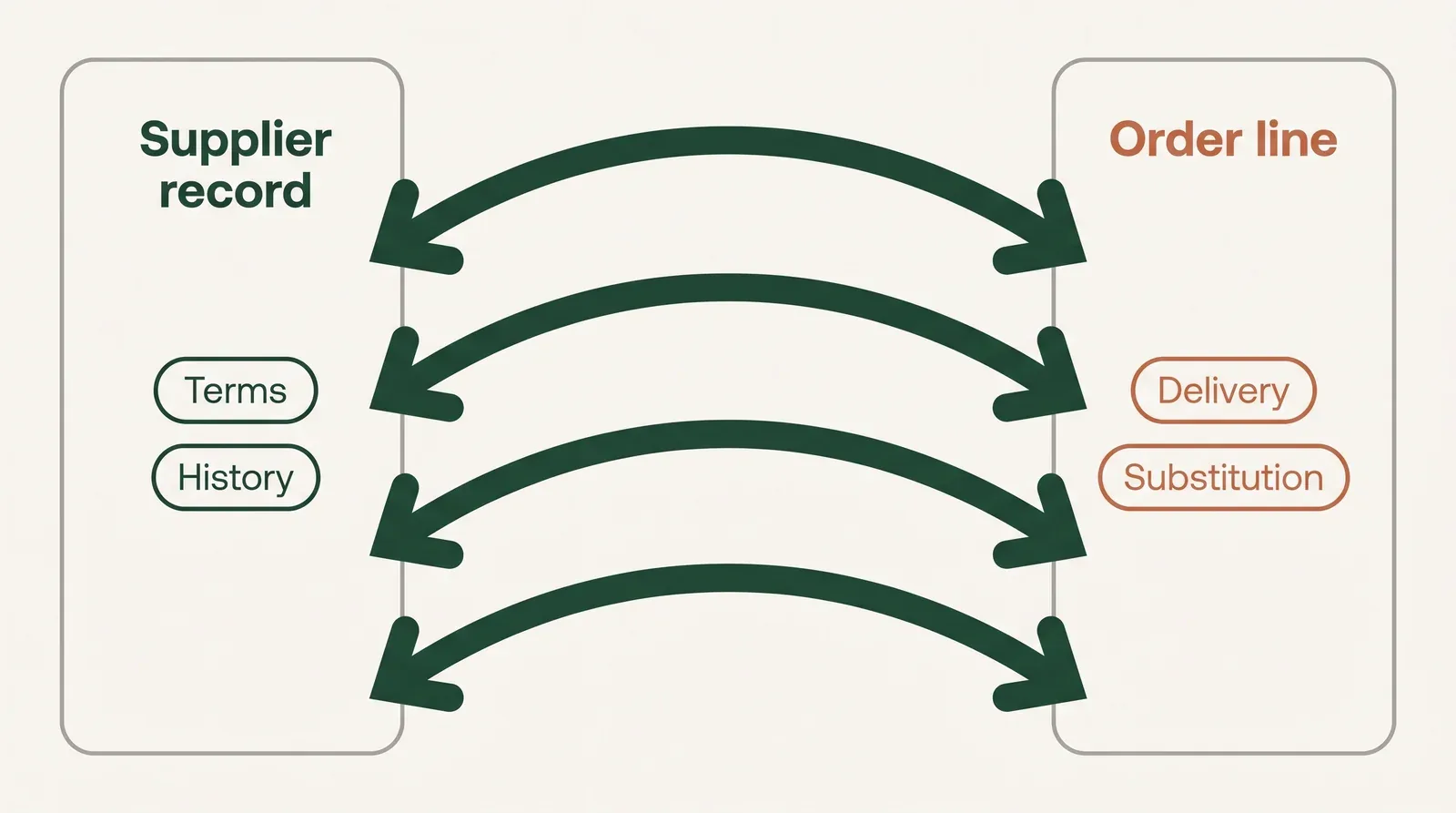
Keeping the supplier record and the orders in two places doesn't break the work into two lighter halves. It adds a third piece of work: realigning by hand what one system knows and the other ignores. That third job has no name, appears in nobody's role description and gets counted by no one — but it turns up at four very specific moments of the week.
Terms that go stale inside a record
A price list sitting in a separate supplier record is true on the day you upload it and starts drifting the day after. A supplier's real terms don't live in a PDF. They live in the price they actually charged on the last delivery, in the minimum order value they raised in September, in the cut-off they moved when they redrew the delivery round. All of which you discover by ordering and receiving — that is, inside the other tool.
For the record to stay true, you'd have to carry every variance you spot on a delivery note back into it by hand. Nobody does that for twenty suppliers, and so after a few months the record describes a supplier who no longer exists. At that point you stop consulting it, and you might as well never have kept it.
The complaint you make without the order line
When you ring a supplier about a wrong delivery, the only thing that matters is the order line: what you asked for, how much of it, at what agreed price, on what date. If the relationship lives in one tool and the orders in another, you make that call either from memory or with two screens open.
You can hear the difference immediately in the tone. "I thought we'd said three cases" is an argument you lose even when you're right. "Tuesday's order says three cases at that price, two arrived" is a statement of fact. And there's a longer-term cost: if the complaint never settles back onto the supplier's record, then a year from now you won't be able to say whether that supplier misses a delivery occasionally or misses one in three.
The negotiation you run from memory
The moment the split costs you real money is the annual conversation. You sit down with the rep. They have your entire buying history on a tablet. You have a contact card and last year's price list. You're negotiating without knowing what share of your spend that supplier carries, which lines you're exposed on, and which ones you could move tomorrow without anyone in the kitchen noticing.
It's the same lag that makes a food cost rebuilt from invoices at month end useless for decisions: the information exists, it just arrives after the decision is made. With the order history attached to the supplier record, that conversation changes character — not because you get more aggressive, but because you stop being the only one in the room who doesn't know what you're both talking about.
The substitution nobody writes down
The line is out of stock, the supplier offers you something else, you take it because service starts in three hours. That is a supplier management decision in every sense — you changed product, probably price, possibly yield — taken inside the order flow and recorded nowhere. Next week the recurring order proposes the original line again, and nobody remembers why that once went differently.
With four or five suppliers the damage stays small, but it scales fast with the count: every extra supplier is another record drifting away from its own orders. That's one of the reasons the number of suppliers is a cost variable and not only a price variable — a point worth reading alongside this one, because it answers a different question than the one here.
What supplier management looks like when it stays attached to orders
Supplier management joined to the order flow is recognisable by one very concrete operational detail: the supplier record isn't an archive of contact details, it's the running account of what you ordered, on what terms, and how it went. You open it not to find a phone number — your phone already has that — but to decide whether to buy from them again.
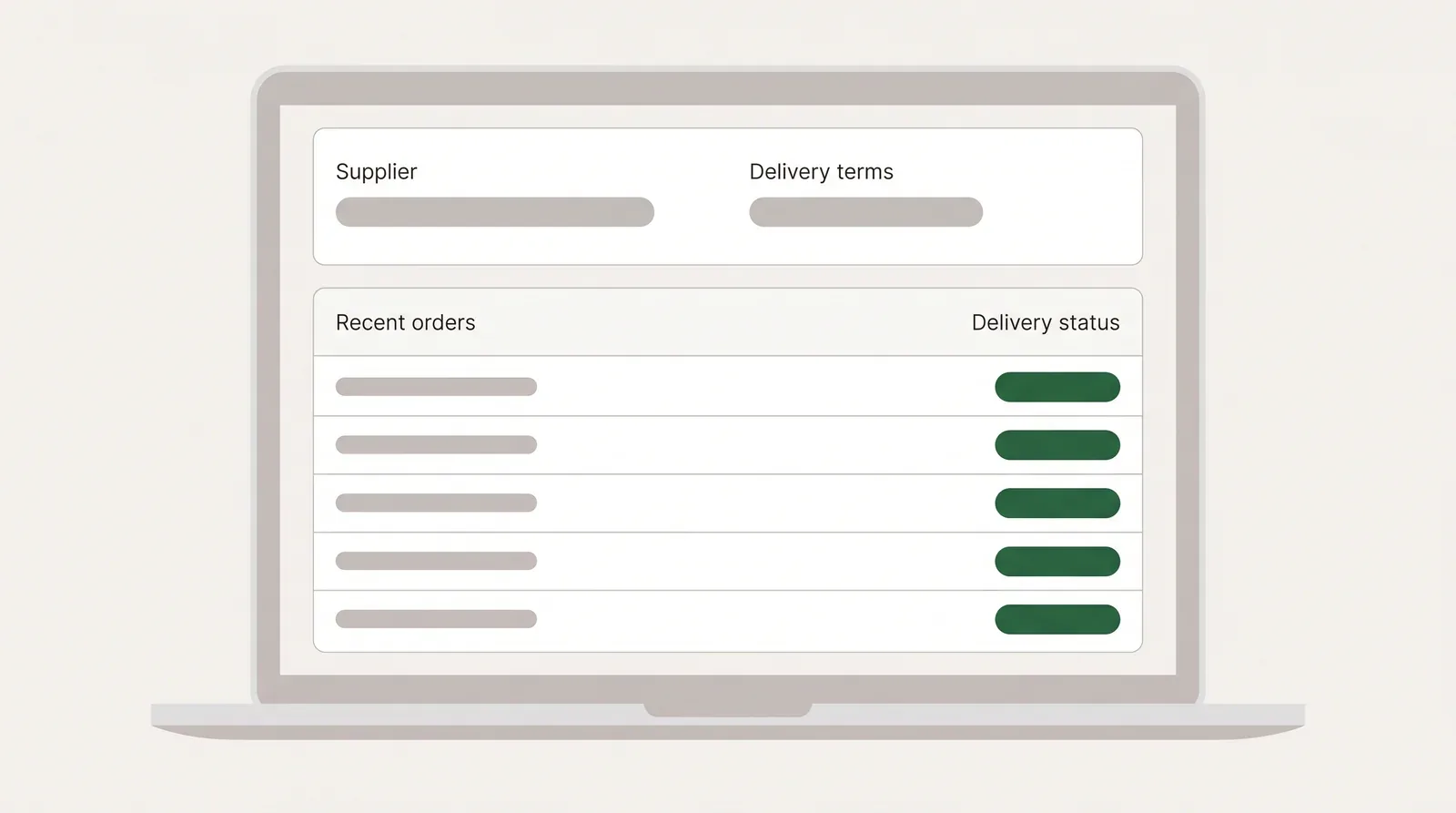
In practice that means four things are visible from the supplier record without opening anything else. The orders you sent them, in date order. The terms they apply now — not the ones they promised, the ones read off recent deliveries. The operational constraints that actually affect you: minimum order value, delivery days, how late you can send an order and still get it in time. And the deliveries that went wrong, with the order line that caused each one sitting next to it.
It works in the other direction too, which is the direction you use far more often. While you're building Monday's order, the line for each product should show the price that supplier charged you last time, not a list price typed in nine months ago. If the price has moved, you find out while you're deciding, not when the invoice lands. It's the same logic as the quantity that ends up in the bin being decided at the order line: the order is the last point where you can still change something, and you need to arrive there already holding the information.
None of this requires exotic features. It requires one structural choice: that the supplier and their orders are the same object in the system, rather than two archives looking at each other from a distance.
Five questions to put to a tool before you adopt it
A tool genuinely holds suppliers and orders together if it survives five questions — all provable in a ten-minute demo, none of them answerable with words. Make whoever is showing it to you do each one live, on their own sample data, and count the screens they cross.
- From a supplier record, how many clicks to see the last order I sent them? If the answer involves an export and a lookup, you're looking at two tools sharing one interface.
- While I'm building an order, can I see the price that supplier charged me last time for this product? This is the question that separates a static catalogue from a live history.
- Where does a delivery problem end up? If the only trace is a free-text note nobody will reread, the complaint will never become a buying criterion.
- If I buy the same product from two suppliers, does the tool notice? It's the most common case in a kitchen and the one a disconnected supplier record gets most wrong.
- When I change a supplier's terms, do future orders pick them up on their own? If you have to remember at the moment of ordering, the tool moved the work rather than removing it.
How we look at it is set out on our page about keeping control of what you spend with suppliers, but the five questions hold regardless — including if you decide to stay on paper and WhatsApp. They exist so you know what you're buying before you buy it.
The five-minute test
You can measure what the split costs you today, without changing anything and without installing anything. Pick any supplier, start a stopwatch, and answer this: over the last three months, which products did I buy from them, and what was I paying for those products in June?
However long that takes is the price you pay every time you need that information — in a negotiation, in a complaint, or while deciding whether to keep the supplier at all. If the answer comes in under a minute, your supplier management and your ordering are already the same thing, whatever tool you use. If it takes ten minutes and ends in a folder of PDFs, you now know exactly what holding them together is worth to you.
Keep your spending under control with mayo
Up-to-date price lists, centralized orders and prices verified on every delivery. Try it with your team.
Keep reading

How many suppliers is too many for your restaurant
The number of suppliers you carry is a cost line nobody negotiates. Here is how to work out, from your own purchasing data, when one more stops paying for itself.