
How much does purchasing software actually save a restaurant? It depends on a check you aren't doing
How much does purchasing software actually save a restaurant? It depends on a check you aren't doing
In short
- Purchasing software doesn't lower prices on its own. The saving comes from putting two numbers side by side, line by line: what you paid per unit, and the supplier's latest price list.
- While orders travel by WhatsApp, phone call and a notebook by the till, nobody runs that check, because the two numbers never sit in the same place.
- What the check turns up is usually small and repeated: 50p more per kilo, a pack size that quietly changed, a discount agreed on the phone that never reached the invoice.
- Software makes the check take seconds. Reading it and ringing the supplier is still your job.
The saving from purchasing software comes from a comparison, not from the program
How much a restaurant saves with purchasing software depends on one thing: whether someone starts comparing the price paid with the price agreed. The program doesn't negotiate. It has never met your dairy rep and has no idea that the fishmonger always rounds up. What it does is put two figures next to each other, and in most independent restaurants those two figures have never been in the same room.
That's why a headline like "save 20% on purchasing" falls apart under a little pressure. The saving isn't a feature of the software. It's the sum of the gaps you find and then fix. A kitchen with punctual suppliers who honour their price lists will find very little. A kitchen where nobody has checked an invoice line in two years may find a fair amount. If you come across a precise figure on a sales page, it's worth knowing how to read a savings percentage before you trust it. The question here is a different one: when a saving does exist, where does it come from?
Why nobody compares the price paid with the price list
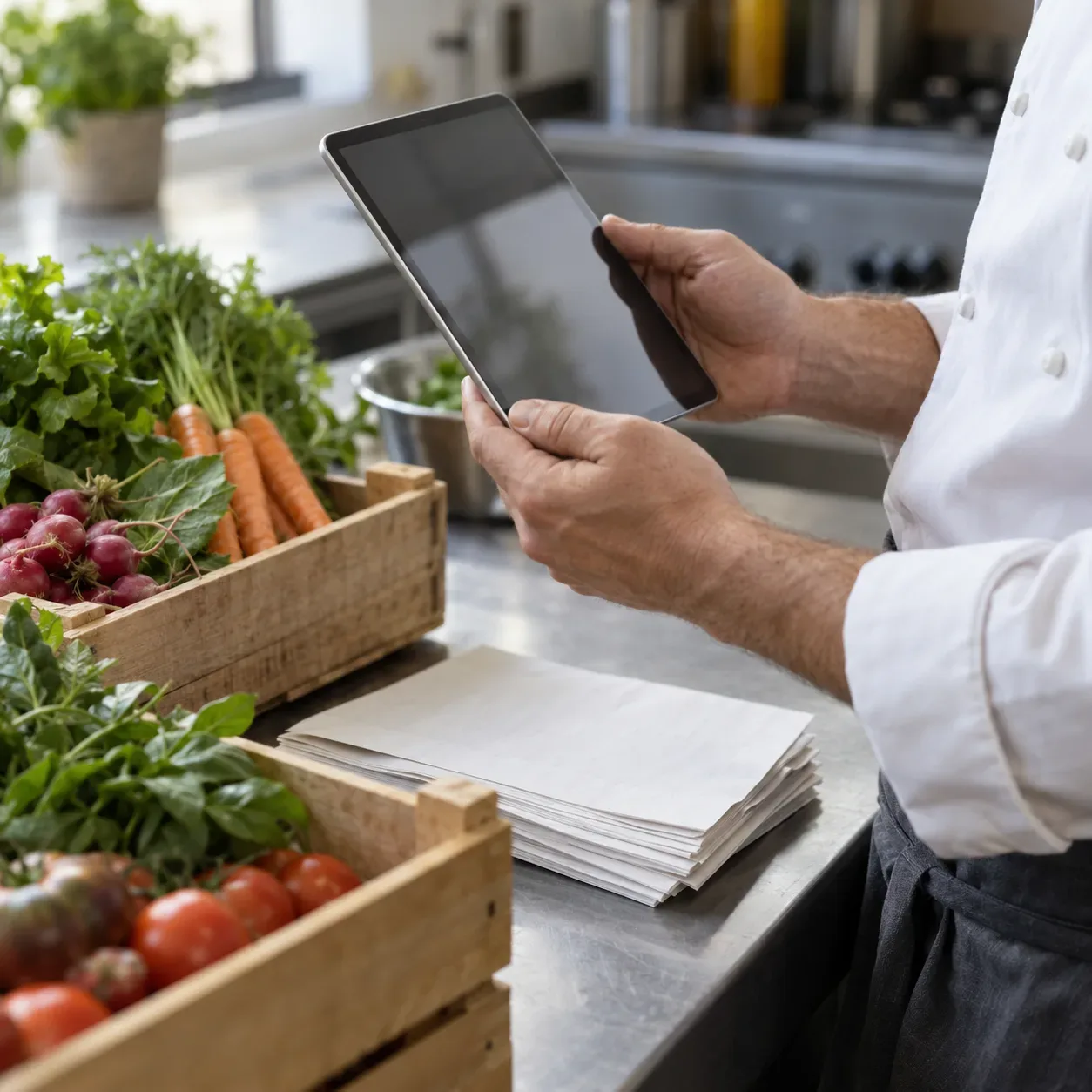
The comparison between price paid and price list goes undone for practical reasons, not lazy ones. The price list arrives as a PDF attachment in January, or the rep reads it out over the phone. The order goes out as a voice note at 11pm, after service. The delivery note turns up with the goods and gets clipped to a board in the back. The invoice lands at the end of the month and goes straight to the bookkeeper.
That's four documents, four channels and four different moments. To know whether Tuesday's butter was charged at the right price, you'd have to dig out the price list, find the line on the invoice, work out the price per kilo, and remember whether you'd agreed anything different on a call since. Nobody does that at midnight. Nobody does it on Monday morning with the walk-in to sort out either. So the invoice gets paid, and the difference, if there was one, becomes part of the dish cost without anyone ever seeing it.
The problem grows with every supplier you add, because each new name is another price list to keep in your head. Before thinking about software at all, it's worth asking how many suppliers a restaurant should keep, since checking costs effort even when the tools make it easy.
How the per-unit check works, on a made-up example
The useful comparison is made on the unit price, never on the invoice total. Totals move every week because quantities move. The price per kilo, per litre or per case should stay put until the price list changes.
Take a hypothetical restaurant with three suppliers: dairy, fruit and veg, dry goods. The dairy price list says unsalted butter is £8.00 a kilo. The invoice shows 5 kg at £42.50. Divide it out and you get £8.50 a kilo, 50p over. On a single delivery that's £2.50, which nobody would argue about. If the kitchen goes through 30 kg a week, it's £15 a week, every week, until somebody notices.
These numbers are invented to keep the arithmetic easy to follow. The mechanism is real: the per-unit gap is small, invisible on any single invoice, and it repeats with every order.
Where the per-unit check finds the gaps
The gaps a per-unit check uncovers nearly always take one of three shapes, and none of them requires a dishonest supplier.
The first is a price list updated without notice, or with a notice buried at the bottom of an email nobody opened. The price goes up a little and stays there.
The second is a pack size change. Olive oil moves from a 5-litre tin at £30 to a 3-litre tin at £19.50. The tin is cheaper, so it looks like a better deal. Per litre it has gone from £6.00 to £6.50. Without a unit price you'll never spot this one.
The third is the discount agreed by phone that never shows up on the invoice: money off dry goods above a certain quantity, free delivery over a threshold. You shook on it six months ago, and the supplier's accounts team never heard about it.
In every case the fix is a phone call. Asking is the easy part. The hard part is having the right line in front of you when you ring.
What purchasing software does, and what stays with you
Good purchasing software removes the reconstruction work. If each order already carries the price-list figure next to every product, comparing it with what you're invoiced no longer means hunting through four documents. The number is already there. That's the case for managing suppliers and orders in one flow: when the price list and the order live in different places, you're back to matching them up by hand.
The tool still won't pick up the phone. It won't decide whether 50p a kilo is worth an awkward conversation, and it doesn't know which supplier carried you on credit through a slow patch. It can give you tracking spend by supplier in real time and show you where the money has moved. What happens next is your call, and that's where the saving either becomes real or doesn't. A restaurant that installs purchasing software and never looks at the gaps has bought a tidy archive, not a saving.
Before you buy anything, run the check on one supplier
The most honest way to estimate what you'd save is to do the comparison by hand, once. Take last month's invoices from your main supplier, their most recent price list, and work out the unit price on the 5 or 6 items you order every week.
Most of the time goes on finding the paperwork, not on the sums, and that tells you something on its own: it's the work nobody in your kitchen has had time to do. If every line matches, look for money elsewhere, in portioning or waste. If two lines are off, you now know what the check is worth in your restaurant.
Keep your spending under control with mayo
Up-to-date price lists, centralized orders and prices verified on every delivery. Try it with your team.
Keep reading
Case study math: “we cut costs 15%” is a headline, not a result
A savings percentage is a ratio, and most case studies never print the two numbers behind it. Four questions tell you whether there is a measurement under the headline — and give you the shape of measuring your own.