

Restaurant Cost Control: Three Numbers Every Monday, Not Thirty KPIs
Restaurant Cost Control: Three Numbers Every Monday, Not Thirty KPIs
The short version
- Restaurant cost control is a habit before it is a set of figures: a few numbers read at the same time every week beat a full dashboard opened whenever you remember.
- The three numbers worth checking weekly are all about purchasing: spend by category as a share of takings, the unit price of your most-bought lines against the last agreed price list, and the gap between what you ordered, what arrived and what was invoiced. They are the only ones you can still act on before the next order goes out.
- Monday works because the week is closed, the delivery notes and invoices are in, and the new order hasn't been placed yet.
- A small rise on something you buy every day costs more than a dramatic one on something you buy once a month.
- The habit only lasts if orders and prices live in one place.
Which numbers should a restaurant check every week?
Every week, a restaurant should check three purchasing numbers, and always the same three: what you spent in each category against what you took, what you pay per unit for the things you buy most, and whether deliveries and invoices match what you ordered. Three, not thirty.
Most guides to restaurant cost control hand you a long list: food cost, labour cost, prime cost, covers, average spend per head, table turns. None of them is wrong. The trouble is that someone running a site with four suppliers and no purchasing manager doesn't look at them regularly, and a figure you don't look at warns you about nothing.
In cost control, then, regularity matters more than coverage. Three numbers read every Monday are worth more than a complete dashboard opened once a quarter.
Why the full dashboard never gets opened
A full KPI dashboard ends up ignored because it asks for more time than you have, and every time you go back to it you have to remember what each figure was meant to tell you.
It usually goes like this. Month one, you fill it in keenly. Month two, a private party eats a week. By month three you only open it when the accountant rings. At that point every number is there, but they describe a stretch of time you can no longer change.
There is a less obvious reason too. A small drift only shows up against the week before, and that comparison only exists if last week you looked at the same number in the same way. A price creeping up, a delivery that keeps arriving slightly lighter than the order: on their own they look like noise. Lined up across four Mondays, they become a trend.
That is why a short routine beats a wide dashboard. Twenty minutes, the same three numbers, the same day: after a month you have four points to compare, and you spot the drift while it is still cheap to fix.
The three Monday numbers
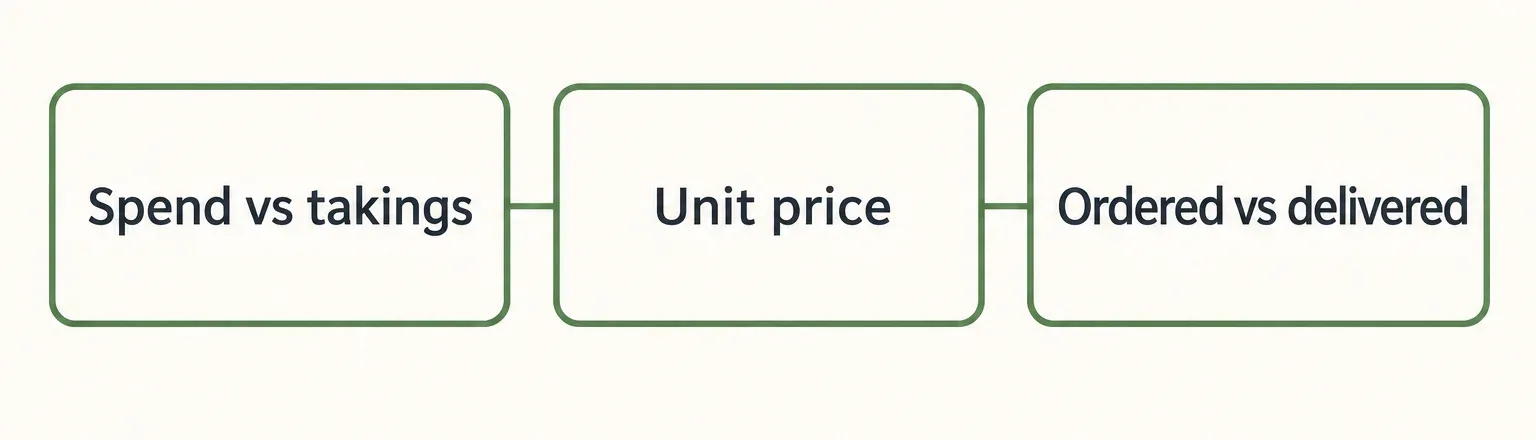
The three Monday numbers are purchasing spend by category as a share of takings, the unit price of your most-bought lines compared with the supplier's last price list, and the gap between what you ordered and what was delivered and invoiced. All three are about purchasing, and that is deliberate: they are the only ones you can still change before the next order goes out. Labour cost or average spend you can read, but you won't move them by Wednesday.
Spend as a share of takings, by category
Purchasing spend as a share of takings is the week's spend in one category (meat, fish, dairy, fruit and veg, dry goods, drinks) divided by that same week's takings. The overall total tells you very little: if the share goes up, you want to know straight away where. And don't hold it up against an industry average, because the useful figure is the one you read against your own history, meaning the Mondays before this one.
One trap: a week's purchases are not the same as a week's usage, because dry goods and drinks sit in stock: one big wine delivery inflates a single week and flatters the three after it. Read this number as a trend, never as a verdict on one week.
Unit price against the last price list
Unit price is what you pay for a product per kilo, per litre or per item, not per case or per pack. Take the five or six lines you buy most often and compare the invoiced price with the last supplier price list you agreed. This is where a change of pack size or a few pence added here and there becomes visible, and it is the same comparison behind what purchasing software actually saves.
Ordered, delivered, invoiced
The third number lines up three documents: the order you sent, the delivery note signed at the back door, and the supplier's invoice. Count the lines that don't match: a short quantity, a product swapped without warning, a price different from the one on the order. You don't need a percentage here. You need to know which lines and which supplier, because those two facts are what let you pick up the phone that same Monday.
Why Monday, and why the closed week
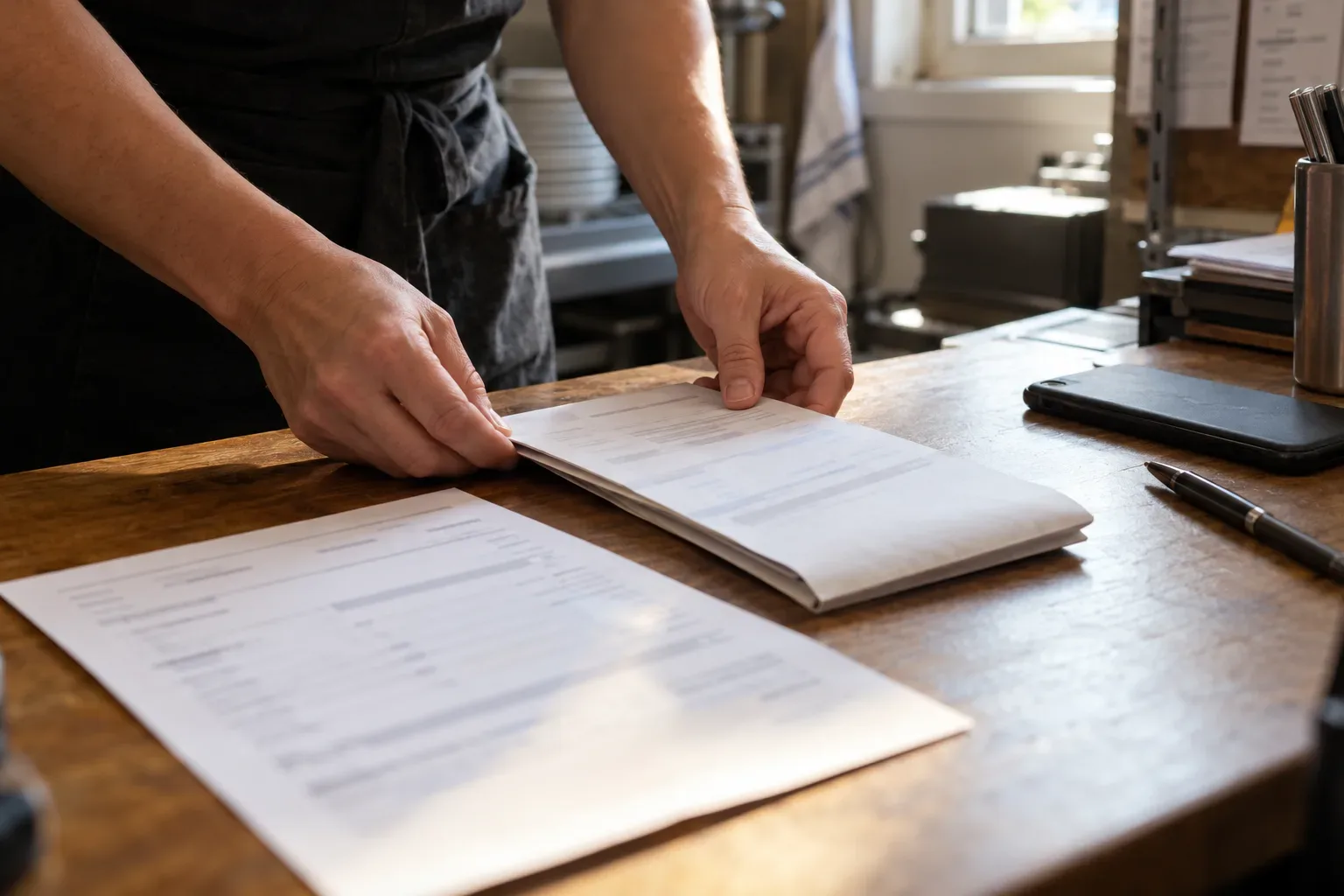
Monday is the right day for purchasing cost control because the previous week is closed, the delivery notes and most of the invoices have come in, and the new order hasn't gone out yet. It is the one moment when you have the full picture and still have time to use it.
The closed week matters as much as the day. Look on a Thursday and half the week is in, half is out, and every comparison is lopsided. A closed week always has the same shape: the same days, the same delivery round, a weekend inside it. Two closed weeks can be compared; two half-weeks can't.
Then there is the order itself. In plenty of kitchens, Monday morning is when the week's standing order gets put together. If you have just seen that a line was invoiced above the price list, or that the same supplier has delivered short twice, you know before you hit send, not after. If your restaurant is closed on Mondays, move the routine to your first day open: the rule is the closed week before the new order, not the name of the day.
How to read a drift (an illustrative example)
You read a drift in unit price by multiplying the increase by the quantity you buy, not by looking at how big the increase is. The example below is made up: the restaurant doesn't exist, the values are rounded, and they are only there to show the sum. They are not market prices.
Picture a restaurant that gets through forty litres of olive oil a week. On the price list it costs £10 a litre; one Monday the owner finds £10.50 on the invoice. Fifty pence sounds like nothing. Over the week it's £20, over the month £80.
In the same month, a speciality cheese the kitchen orders only once, two kilos at a time, goes from £20 to £26 a kilo. The jump is obvious and everyone in the kitchen notices. Over the month it comes to £12.
Put on the same scale, the increase that made all the noise costs less than a sixth of the one nobody spotted. And the fifty pence comes back on every order until someone rings the supplier.
You will see the dramatic increase anyway; the small one on a frequent line you only see if you compare unit prices every week. If instead you work out your food cost at the end of the month, that difference reaches you as a thinner margin, with no label saying where it came from.
What it takes to do it in twenty minutes
Monday cost control only fits into twenty minutes if orders, prices and paperwork are in one place. If the order is in a chat, the price list in a PDF someone emailed and the invoice with the accountant, you spend the first half hour of every Monday piecing things together, and by the second week the routine has gone.
The bottleneck is almost never the maths; it's the gathering. You already have takings from the till. What's missing is the unit price of every order line next to the price list, and the order, delivery note and invoice from each supplier side by side. When orders go out through different channels, keeping a single order history is what lets you read the second and third numbers instead of rebuilding them.
mayo keeps your supplier orders and prices in the same place, so unit prices and each supplier's history are there to look up without stitching scattered invoices back together, and that is where restaurant spend control starts. A spreadsheet works too, as long as it is always the same one and you update it with every order.
If you want to start this Monday, don't begin with all three. Start with the second number, on one product only: the one you buy most often. Write down what you pay for it per kilo or per litre, and next Monday check whether it has changed. That is the smallest piece of cost control there is, and it is enough to tell you whether the other two are worth adding.
Keep your spending under control with mayo
Up-to-date price lists, centralized orders and prices verified on every delivery. Try it with your team.
Keep reading

Restaurant Purchasing Analysis: Ask Your AI Agent the Question Your Dashboard Never Asked
A dashboard only answers the questions someone predicted. With an AI agent connected to mayo, read-only, you ask the one you actually have, in plain English.

There Is No Ideal Food Cost. There Is Only Your Format
The 28-35% food cost band everyone repeats describes full-service restaurants and nobody else. A pizzeria and a bar are measured wrong by it, in opposite directions.

The food cost you calculate at month-end is an autopsy
The food cost formula was never the problem. The problem is when the number shows up — thirty to forty-five days after the price that produced it changed.