

Overstock and stockouts are the same mistake: fear of running out fills the bin
Overstock and stockouts are the same mistake: fear of running out fills the bin
Key takeaways
- An ingredient that runs out mid-service is visible at once, with a time stamp and someone to blame. Surplus sitting on a shelf is silent: it expires days later and the waste gets pinned on the kitchen, not on the order.
- Whoever has been caught short once orders more next time, as insurance. Fear of the stockout manufactures the overstock.
- Gap and surplus share one root: a quantity chosen without knowing what is really on the shelf or what was used. That is why "order less" and "order more" move the mistake around without removing it.
- The fix is a stable number per product, an order-up-to level. The order is that level minus the stock you counted, and the level comes from what you actually used over recent weeks.
- The rule holds for long-life goods. For fresh produce, peaks and seasonal items, you change the level on purpose, not on instinct.
A gap in the walk-in shows at once; a surplus does not
Restaurants get quantities wrong in the same direction again and again because the two failures are not equally visible. An ingredient that runs out during service shows up the moment it happens: a ticket stuck on the pass, a dish struck off the specials, front of house asking what went wrong. It has an hour, a day, and almost always a culprit, because somebody wrote the order.
A surplus works the other way round. 3 extra cases interrupt nothing. They sit at the back of the fridge behind whatever you use daily. The cost lands days later, when someone finds the date has passed and bins the lot, and the question asked then is "who let this go off?", which points at the kitchen. Nobody asks "who ordered 3 more than we needed?" The waste is booked where it is seen, not where it began.
The result is lopsided bookkeeping. A stockout leaves a sharp scar: you remember the Friday, the product, the guest's face. A surplus leaves some scattered scrap with no date and no name. Take an invented month: you ran out 2 times and threw stock away 5 times. You can name the day and the hour of the 2. You cannot name the 5. That gap in memory, not a gap in severity, decides which way your quantities lean.
How fear of running out manufactures the waste
A cook or manager who has run out of a product once tends to order more of it next time, as insurance, and this habit is among the commonest causes of overstock in a kitchen. The insurance is rational for the person buying it and expensive for the business paying for it, because the premium never appears on any bill.
Here is a hypothetical, with made-up numbers. One Saturday the Parmesan runs out halfway through service and the chef has to pull 2 dishes. The following week, writing the order, the chef remembers that Saturday and doubles the usual quantity. Double is enough to cover the next Saturday and also every weekday, when Parmesan barely moves. Stock piles up, some of it expires, and 2 weeks later the owner sees the scrap and asks for orders to be cut. The chef cuts them. On the 3rd Saturday the Parmesan runs out again, and the cycle restarts.
Nobody is at fault in that story. The chef is reacting to a real sting, the owner to a real cost, and the two reactions cancel each other out in a loop that can run for months. A quieter version of the same loop is the early delivery. If a supplier only drops on certain days, ordering ahead "just in case" fills the shelf with 2 or 3 days of consumption instead of 1, and the goods that arrive early are the first to expire. Insurance against running out is paid for in freshness.
None of this says ordering more is always wrong. If a supplier delivers once a week and you need a product every day, a buffer makes sense. The trouble is that a buffer added as a defence has no criterion behind it: it is last time's fright converted into cases. We covered why the quantity is decided at the moment of ordering, not in the cold room, in how to reduce kitchen food waste by changing how you order. What this piece adds is the bias: after a gap, that decision always tilts towards surplus.
Overstock and stockouts share one mistake and one missing number
Overstock and stockouts come out of the same decision: a quantity picked without knowing what is truly on the shelf or what was used in recent weeks. That is why ordering less and ordering more fix nothing. Each one pushes the error to the other side.
Put the two cases next to each other. In the first, you ordered too little because you thought you had more than you did, or because weekend consumption ran higher than you remembered. In the second, you ordered too much because you thought you had less, or because you remembered a higher run rate than the real one. Both times the missing figure was the same, and it was missing at the same moment: when you were writing the order, phone or notepad in hand, working from memory.
When quantities are set from memory, each person's behaviour depends on whatever they lived through last. The chef who has just survived a Friday without fish orders generously. The owner who has just watched a skip fill with salad leaves orders tight, or asks the chef to. 2 people look at the same section with 2 different recollections, and each is right about their own. Who sets the quantity, the chef or the owner, matters less than what is in front of them when they set it. If it is a memory, the error changes shape with the latest incident.
Measuring what waste costs is a useful step, and we walk through it in how to work out what food waste really costs your restaurant. But the cost of waste on its own pushes in one direction only: it tells you to order less. The gap, which that figure does not capture, pushes the other way. You need both numbers, stock and usage, to stop swinging.
One reference quantity per product, not one rule for everything
An order-up-to level is a maximum fixed for each product: instead of deciding how much to order every time, you decide once how high to fill, then order the difference between that level and what you have counted. The order becomes level minus stock on hand. One number is stable, one is counted.
A hypothetical example with round, invented figures. For mozzarella you have set the level at 20 kilos. Before ordering you count: 6 kilos on the shelf. You order 14. Next week 11 are left, so you order 9. You did not need to recall how the weekend went or what you ordered last time. You needed the level and the count. Notice what does not happen as well: the bad day does not move the number. The level changes deliberately, not because one Friday burned you.
How do you find the level? From real usage over the last few weeks, not from the mood of the moment. Take one product and look at how much you used in each of the last four to six weeks, which is what you ordered, plus stock at the start, minus stock at the end. Between one delivery and the next you have to cover the usage of that interval. The level is the usage of the stretch your supplier leaves you uncovered, plus a reasoned margin for strong weeks. The margin is the part usually decided by fear. Here you set it by looking at the highest week you have actually seen, not the one you remember most painfully.
Two cautions avoid the common errors.
The first is that you need a level per product, not a blanket rule. "Always hold two days of stock" sounds sensible and is not, because mozzarella and olive oil differ in usage, shelf life and delivery rhythm. A single rule gives you stockouts on fast movers and overstock on slow ones, which is the problem you started with. You do not have to do the whole storeroom either. Start with the five or ten products that cost the most, or that have left you short most often.
The second is that the level only works if you count. A reference with no stock figure is a number with no use: if you find out what is there by glancing into the fridge, the estimate errs in whichever direction suits you at that moment. The count can be quick and rough, in cases and packs rather than grams, as long as it happens before you write the order and not after.
Where the rule needs bending: fresh produce, peaks and seasonal items
An order-up-to level holds well for long-life goods, and has to be adjusted on purpose for short-life fresh produce, for busy peaks such as weekends and events, and for seasonal items. Where goods have few days of life, the maximum cannot follow usage alone. It also has to follow how long the product stays good.
For short-life fresh items, such as fish, herbs and some vegetables, a high level is a risk, because the extra stock does not wait. If a product lasts 3 or 4 days, a level built for a week binds you to throw away roughly half of it. Here the level tends to be low and the deliveries frequent: better to order small and often than large and rarely. For long-life goods, such as oil, tins and dried pasta, the cost of surplus is mostly money tied up on a shelf, and the risk of running out weighs more, so the level can be more generous without much harm.
Peaks are the exception that breaks the average. A weekend uses more than a weekday, and a booked event uses more than an ordinary weekend. Set the level on the average and you are short exactly when it matters. Set it on the peak and you carry extra stock every other day. The answer is two levels, one for a normal week and one for a peak week, and you switch between them when you know an event or a busy season is coming, not once it has arrived. Here too the number moves because you have a written reason, not because you are frightened.
Seasonal items are the awkward case: they appear, sell for a few weeks and vanish. You have no long history to build a level from, so you start cautious, count often, and adjust after the first week with real usage. Better to err low on the first order of a new product and notice it through a small, declared gap than to err high and hold stock nobody knows the life of.
What to ask of a tool that keeps the number for you
A tool is useful for this method if it holds, for each product, the maximum level and the stock you declared, so the order starts from two written numbers and not from the memory of whoever fills it in. 3 questions to put to any vendor in a demo:
- Can I set a maximum quantity per product and change it when I need to, or is it one setting for everything?
- Can I declare stock before ordering, without copying it in from somewhere else?
- When goods arrive, can I see whether what came in matches what I asked for?
In mayo you can declare stock and set a preferred maximum quantity for each product (a Pro plan feature). Those are the two numbers in this article, and they stay recorded per product instead of living in a spreadsheet or in the head of whoever orders. The order is prepared in the order wizard and goes to the supplier by email or WhatsApp, on every plan. At delivery there is check-in, which lets you verify the goods line by line; we covered that in how to catch order errors by checking goods at delivery.
mayo does not calculate the quantity for you or tell you how much to order: you choose the maximum, looking at your usage, and you declare the stock. To see how these pieces fit together, the page on how to keep restaurant spend under control is the place to start.
If you would rather try the method with no tool at all, pick five products today and write beside each the level you want to fill up to. Next time you order, count before you write. The first number you invent will probably be wrong. You will correct it by looking at what happened, and for the first time you will have something written down to correct.
Keep your spending under control with mayo
Up-to-date price lists, centralized orders and prices verified on every delivery. Try it with your team.
Keep reading
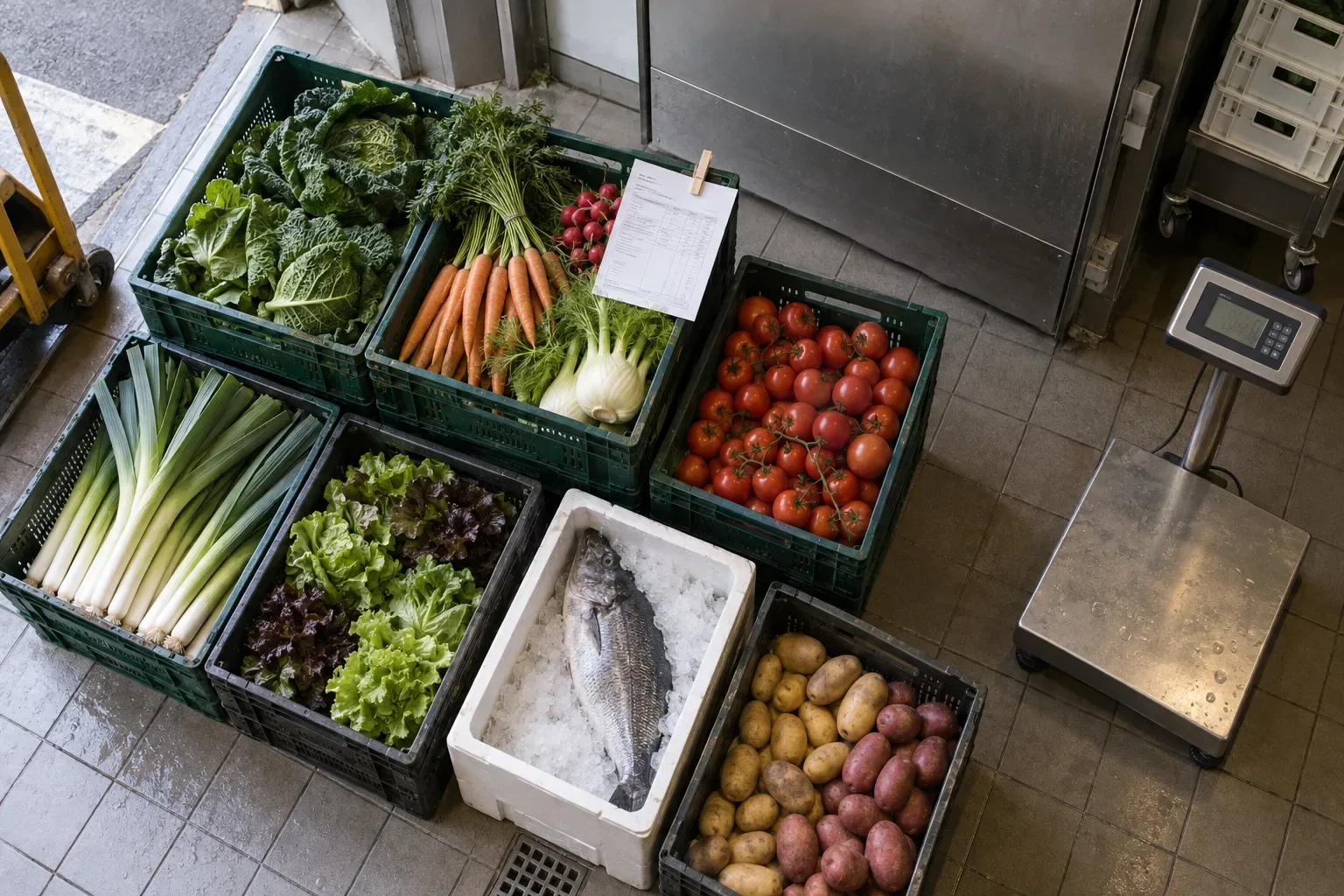
A Binned Kilo Costs More Than You Paid for It: How to Put a Value on Food Waste
What you throw away in the kitchen costs you three different things, each with a different degree of certainty, and none of it shows up in your accounts because it hides inside food cost. To see it, you have to separate ordered, sold and binned.
The food you throw out was decided on an order line, not at the cutting board
Rotation, portioning and trim reuse all work on product you have already paid for. The quantity that created the waste was chosen days earlier, at the order — and that is the only place the number really moves.