

The food you throw out was decided on an order line, not at the cutting board
The food you throw out was decided on an order line, not at the cutting board
In short
- Waste becomes visible in the kitchen, so it gets charged to the kitchen. The quantity that made it possible was chosen days earlier, on an order line.
- Rotation, portion control and trim reuse act on product you have already bought and already paid for. The most they can give back is a fraction of its value.
- Three ordering habits produce most of it: repeating last week's order, taking a supplier minimum without doing the arithmetic, and treating the purchase unit as if it were the consumption unit.
- Setting a quantity honestly takes consumption history per item, checked against what is really on the shelf — not the estimate you make standing in the doorway of the walk-in.
- You do not have to fix ordering everywhere at once. Take the few perishables that account for most of the value in the trash, track them for two or three order cycles, and correct only those.
Where the food you throw out actually comes from
The product in your trash entered the building on an order line somebody approved days earlier. The kitchen inherits a quantity it did not choose, and by the time anyone sees the problem, the only remaining decision is what to do with a case of romaine that has three days of life left and two days of demand ahead of it. Waste gets recorded where it becomes visible, which is almost never where it was decided.
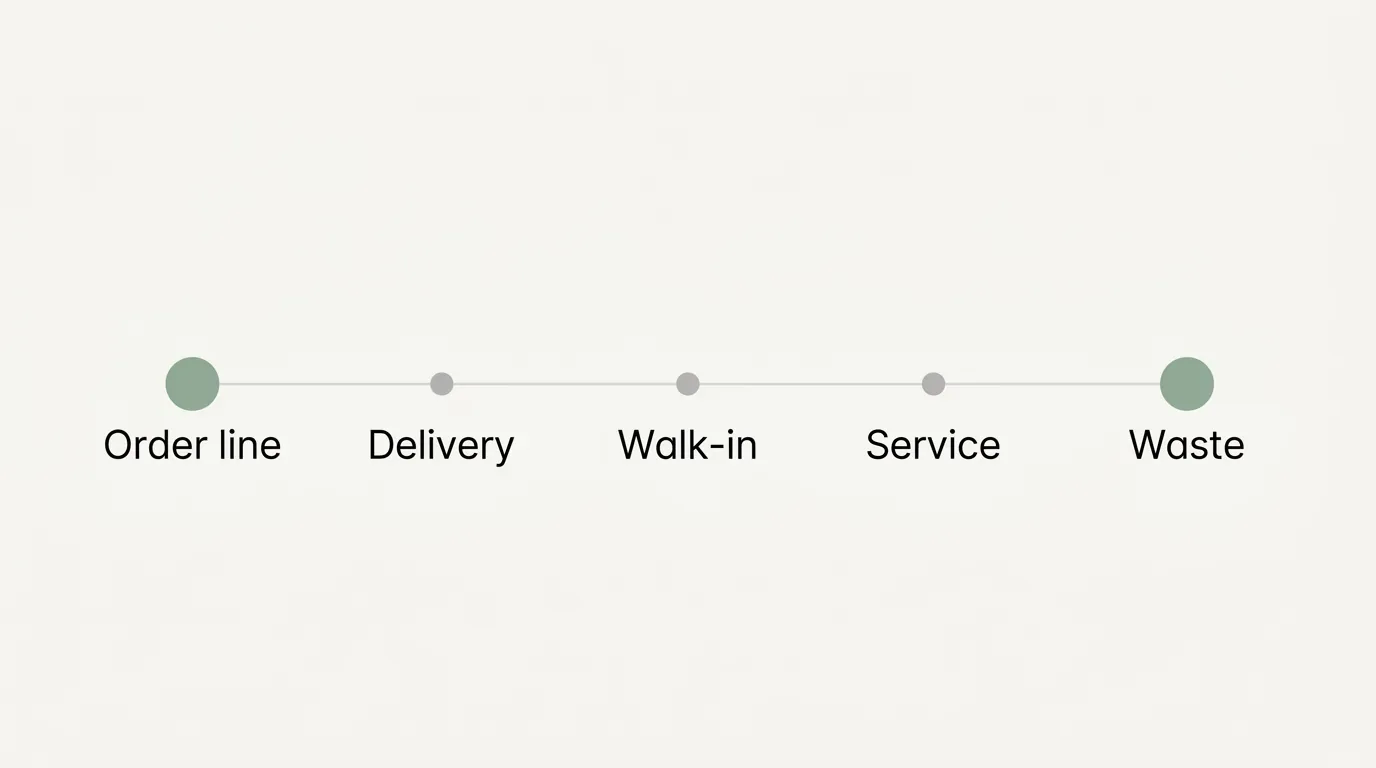
Watch how the quantity actually gets set. It is Tuesday morning, the cutoff is at eleven, and you have a delivery landing Thursday. You have maybe ninety seconds per line. So you use what is in reach: what you remember about last weekend, what you can see stacked in the walk-in without moving anything, and the order you sent last week. None of those three is consumption history. They are a memory, a partial view and a copy.
That is why a repeat order is such a reliable way to reproduce last week's waste. If last week you bought four cases and threw out most of one, and this week you send the same four, you have not made a mistake — you have made the same decision twice, and only one of the two times did you have any information about it. The order line is where the money leaves. Everything downstream is damage control.
There is a test for this that costs nothing. Next time something goes in the trash, don't ask what the kitchen could have done with it. Ask which order line it came in on, and whether you would sign that line again knowing what you know now. Most operators who try it find the answer is no, and find it quickly.
Why the anti-waste playbook in the kitchen arrives late
FIFO rotation, standard portioning, trim reuse and menu engineering are correct practices, and they operate on product you have already bought and already been invoiced for. At that point the cost is sunk. The best available outcome is recovering some of the value, and recovery is worth less than the thing it recovers.
Take the trim. Carrot tops into staff meal, chicken bones into stock, day-old bread into croutons — all of it real, all of it worth doing. But the invoice for those carrots does not change. What you get back is culinary value on a plate you were going to have to fill anyway, and you get it back at the cost of labor you also have to pay for. That is a decent trade. It is not the same order of magnitude as not buying the third case.
The same timing problem shows up in the numbers. If you only find out what an item really cost you when the invoices are coded and totaled at the end of the month, you are reading a post-mortem: a food cost computed at month end is an autopsy, because the cost was decided at the moment of purchase. Menu engineering has the same lag built in. It tells you which dishes to push based on how they sold, which is useful, and it tells you nothing at all about the quantity you committed to before any of them sold.
None of this is an argument for dropping rotation or portion standards. Drop those and you add a second source of waste on top of the one you already have. It is an argument about sequence: the practices in the kitchen are the second lever, and almost everyone is pulling them first because they are the ones you can see.
The three ordering decisions that create most of the waste
Three habits at order time generate most of the avoidable waste in an independent restaurant: repeating the previous order without checking it, accepting a supplier's minimum order without pricing the excess, and ordering in one unit while cooking in another. All three are invisible on the order screen and obvious in the trash a week later.
You repeat the order instead of deciding it
A repeat order carries last week's demand into a week that is not last week. Different weather, a holiday nobody flagged, a large party that canceled, a special that ran out on Friday and skewed everything after it. The standing order is a convenience that quietly asserts that nothing changed. Some items genuinely tolerate that — dry goods, canned product, anything with months of shelf life. Short-shelf-life produce, fresh fish, dairy and prepped items do not, and those are the items sitting in the trash.
You take the minimum without pricing the excess
A minimum order value or a case-only break looks like a discount because the unit price drops. It is a discount only if the extra volume gets sold before it dies. Nobody runs that check at eleven on a Tuesday. And the more suppliers you carry, the more separate minimums you have to clear every week, each one nudging a quantity up a little past what the week needs — which is one of the reasons how many suppliers you run is an operational variable and not just a purchasing preference.
You order in cases and cook in portions
You buy in the purchase unit — case, flat, sack, five-pound bag — and you cook in the consumption unit, which is portions on plates. The conversion between them is set by the supplier's packing, not by your menu. A case that yields, for example, sixty portions of a garnish you sell twelve of a week is not an ordering error anyone made deliberately; it is a unit mismatch nobody converted. On the receiving counter that mismatch finally becomes physical, and by then it is in the building.
The number that is missing when you set the quantity
The input that would make an order quantity defensible is consumption history per item, checked against real on-hand stock. Most independent operators have neither in front of them at order time. What they have instead is a look at the walk-in, and a stacked crate hides whatever is behind it, so on-hand ends up estimated rather than read.
Consumption history means what you used, not what you bought. That distinction is the whole point, because the two figures diverge by exactly the amount you threw away. A purchase history tells you that you have been buying four cases a week for a year. It will keep telling you that for as long as you keep doing it, and it will never once tell you that three would have been enough. Only usage separates the two, and usage has to be recorded at the point where product leaves the shelf.
The second input is real stock at the moment you order, not at the moment of last month's count. This is where high-turnover perishables punish you hardest: an item that arrives Thursday and dies Monday has no margin for a wrong estimate, and it is also the item you are least likely to have counted, because counting it feels pointless when it turns over so fast. It is the opposite. The faster the turn, the more often a bad quantity gets repeated.
Put those two together and the order quantity stops being a guess. It becomes a subtraction: what you actually use across the cycle, minus what is actually on the shelf, plus whatever cushion you decide to carry deliberately. It also moves the decision to where it belongs — to the point where spend is committed rather than the point where it is reported. The cushion is fine, by the way, as long as you choose it. Most waste is not a chosen cushion; it is an unchosen one.
How to change the way you order, without rebuilding the kitchen
Changing how you order starts on a shortlist of high-turnover perishables, not on your whole order guide. Pick the handful of items that account for most of the value going in the trash — in a lot of kitchens that is a dozen lines or fewer — track what you really use on those for two or three order cycles, compare it with what you ordered, and correct the quantity on those items alone. Everything else keeps running the way it runs.
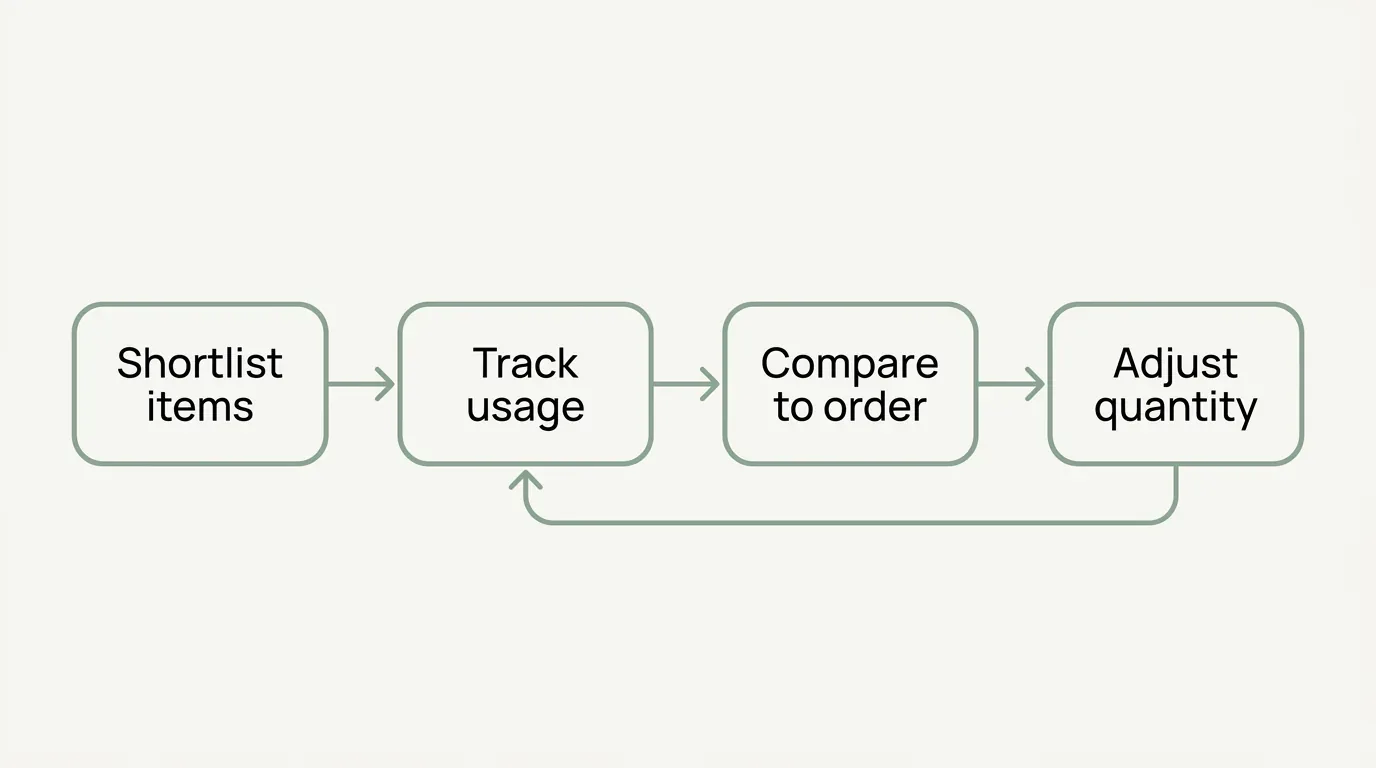
The shortlist has to be small enough that one person can count it without a system, because at the start you will not have one. A clipboard by the walk-in door and thirty seconds at close is enough to produce the only data that matters here. Two or three cycles is an example cadence, not a rule — the real threshold is when the pattern stops surprising you, and on a weekly delivery that tends to land somewhere in that range.
Then correct in one direction and hold it. Cut one item by one unit, keep the shortlist running, and see whether you ran out. Running out once is information; it tells you where the floor is, and you can only find it from above. Cutting four items at once tells you nothing, because when service gets tight on Saturday you will not know which cut caused it.
The software question comes after this, not before. Once the shortlist works, the obvious move is to make the count and the history live where you place the order, and that is where a lot of operators discover that an ordering module inherited from an inventory system was never built for ordering in the first place — it can tell you what you own and not what you keep using. It is worth knowing that before you buy something to solve it.
What you are really buying with all of this is a different conversation with your kitchen. Right now, when something gets thrown out, the discussion is about handling: who rotated what, who over-prepped, who forgot to label. Once the order line is visible, that discussion becomes a question about a quantity you signed off on, and it belongs to you rather than to the line cook holding the bin. That is an uncomfortable trade for about a month. It is also the only version of the conversation where the answer actually changes anything.
Keep your spending under control with mayo
Up-to-date price lists, centralized orders and prices verified on every delivery. Try it with your team.