

A Binned Kilo Costs More Than You Paid for It: How to Put a Value on Food Waste
The short version
- A binned kilo costs you three separate things: the price you paid, the labour already spent if it had been prepped, and the margin you never took. Only the first is certain.
- Lost margin only exists if that dish would actually have sold. On stock you over-ordered, that sale was never there.
- Your accounts have no line for waste. It sits inside food cost, mixed in with supplier prices and your dish mix, so a high food cost doesn't tell you what went wrong.
- You only see waste by separating three quantities, per product and per period: ordered, sold, binned. Plus whatever is still in the walk-in.
- Value it at the price on that order's invoice, not today's price list, and keep the three items in separate columns instead of adding them into one figure.
A binned kilo costs more than you paid for it
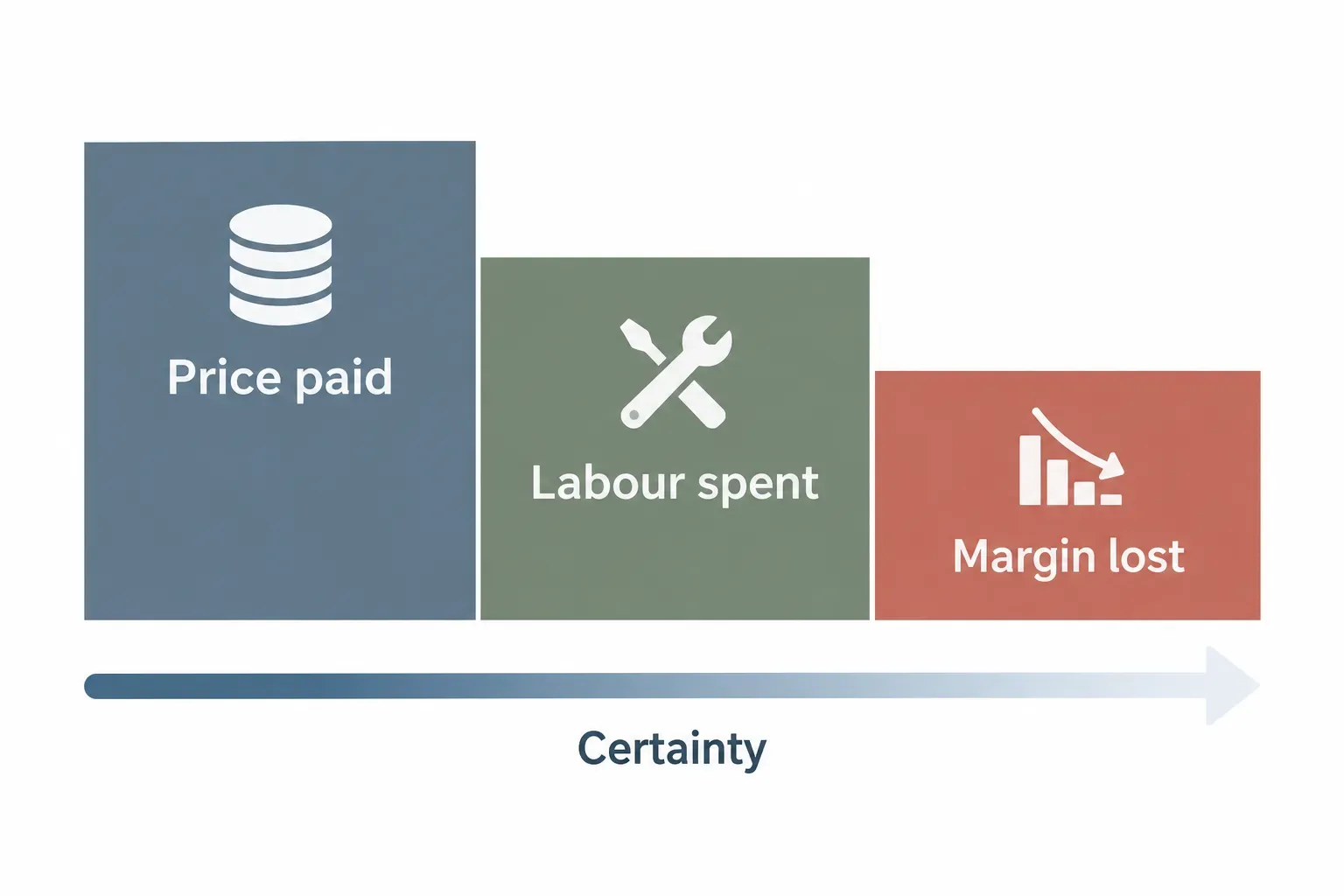
The purchase price is the only certain part of what food waste costs you: you've paid it, it's on the invoice, and it isn't coming back. But it isn't the whole cost. On top of it sit two more items, the labour already spent and the margin you didn't take, and they only count in certain cases.
The first item is straightforward. You buy a box of courgettes and bin a third of it because it's gone soft: you've lost a third of the price. No argument there.
The second item only appears if the stock had already been prepped. A whole courgette in the bin costs you the courgette. A tray of grilled courgettes binned at the end of service also costs you the time of whoever washed, sliced and grilled them, plus the gas. That's a real cost, but less certain than the first: you'd have paid the cook anyway, and that time only becomes a loss if it could have gone on something else.
The third item is the one people get wrong most often. Lost margin only exists if the waste cost you a sale. If the walk-in fails on Friday and on Saturday, with a full dining room, you take the sea bass off the menu, you would have sold those portions: that margin really is gone. If instead you bin the sea bass because you bought too much and the demand wasn't there, you haven't lost any margin. You've lost the price. Counting margin on a sale that was never going to happen inflates the number, and an inflated number is the first one everyone stops looking at.
Why food waste doesn't show up in your accounts
Food waste has no line in the accounts. It goes into cost of goods sold, and so into food cost, along with everything else. Cost of goods sold works like this: opening stock, plus purchases, minus closing stock. What you binned left the walk-in exactly the way what you served did, and as far as the books are concerned they're the same thing.
The upshot is that a rising food cost can have at least three causes, and the figure on its own won't tell them apart:
- Supplier prices went up. Same quantities bought, same sales, dearer invoices.
- Your dish mix shifted. You sold more low-margin dishes and fewer high-margin ones, without binning anything extra.
- You binned more stock. Prices flat, menu unchanged, but some of what you bought never made it to the pass.
Three causes, three different fixes: renegotiate, rework the menu, order less. Look only at the percentage and you risk applying the wrong one. And if you only see that percentage at the end of the month, pieced together from invoices, the problem doubles: it's a food cost figure that arrives after the margin has already gone, telling you something went wrong without telling you what.
For the same reason there's little point comparing your food cost with some "correct" percentage from outside. Quite apart from the fact that the right food cost target depends on the kind of place you run, an outside average has the same flaw as yours: the waste is in there, mixed in with everything else.
Three numbers to keep apart: ordered, sold, binned
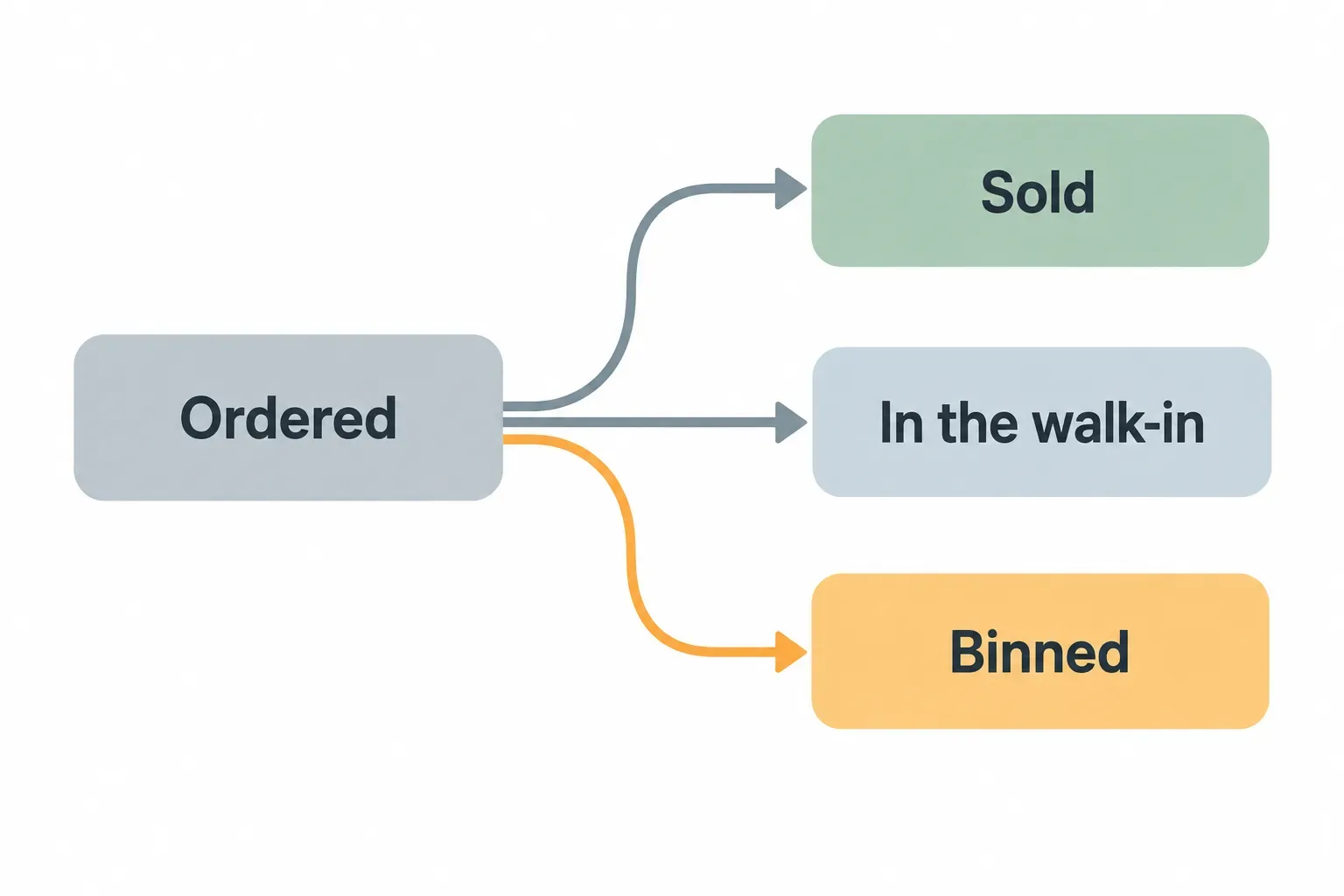
Food waste only becomes visible when you write down, for each product and over the same period, three separate quantities: ordered, sold, binned. Add to those whatever changed in the walk-in between the start and end of the period, or a week when you stocked up will look like a week of waste.
Each of the three has its own source, and none of them lives in the same place as the others.
- Ordered lives in your orders and invoices: quantity and price, supplier by supplier.
- Sold lives in the till, but the till counts dishes, not kilos. To get from "forty steaks" to kilos of sirloin you need the portion weight from the recipe.
- Binned lives nowhere until you write it down. A sheet pinned up by the bin, a scale, and a rule that whoever bins something weighs it and notes the product and the reason: out of date, prep trim, spoiled, sent back from the floor.
You don't need to do it for everything. Start with the products that cost you most: fish, meat, fresh dairy. There, a small difference in kilos is a big difference on the invoice.
Put the three numbers side by side and they almost never add up. Ordered minus sold minus binned minus the change in the walk-in leaves a remainder. That remainder isn't a flaw in the method; it's information: portions bigger than the recipe says, stock invoiced but never delivered, staff meals, or waste nobody weighed. Before you had the three numbers apart you couldn't see that remainder, because it was all lumped together inside food cost.
How to put a value on what you bin
To value food waste, use the price you paid on that order's invoice, not today's price list and not an average for the year. Then add labour only for stock that had already been prepped, and lost margin only where the sale was plausible. And keep the three items in three columns.
The invoice price matters because prices move. If you paid less for the fish you binned on Thursday than it costs today, valuing it at today's price shows you a loss you never had. Watch the units too: if the supplier invoices by the case and you weigh waste in kilos, work out the conversion once, properly, and stick to it.
A made-up example, just to show the arithmetic. On Thursday you bin 2 kg of sea bass invoiced at £15 a kilo: that's £30, certain. Of those 2 kg, one had already been filleted, so you note separately, as an estimate, the time of whoever prepped it. You don't count margin, because the sea bass was left over against demand that wasn't there. The line in the log doesn't say "waste: £30 plus the dishes not sold". It says: £30 certain, a labour estimate noted separately, zero margin, reason "over-ordered".
Three columns instead of one number serve a specific purpose: when you go through it with your business partner or your head chef, nobody argues with the first column. Add them together and everything is up for argument, starting with the weakest figure.
Unavoidable and avoidable waste

Some of what you bin can't be eliminated: peelings, bones, fish frames, the fat you trim off, the weight lost in cooking. That's unavoidable waste, and it belongs in the recipe's yield, not in the waste log. The number that matters is avoidable waste, because it's the only part you can get back.
The distinction changes the maths. Put the carrot peelings in the log as well and the total grows, but there's nothing you can do about it: carrots have to be peeled. Buried in that total is the part you could have avoided: the bunch of parsley bought and never opened, the tub of ricotta that went out of date at the back of the walk-in, the second tray of lasagne made for a Saturday that never filled up.
Avoidable waste nearly always has the same origin: you bought more than you needed. That's why how much you end up binning is decided when you place the order, not at the stove: the log tells you what it's worth, and the next order is where you change it.
Where you need the price of every order
To put a value on waste you need the price paid for that particular order, and that price lives in the order and in the supplier's invoice, not in your till system. The till knows how many dishes you sold and at what price; it doesn't know what Thursday's sea bass cost you.
If your orders go out through different channels and the price only surfaces when the invoice turns up weeks later, every time you weigh some waste you have to go looking for it. In mayo the price of every order stays on record line by line, and that record is what spend control by supplier and by product is built on.
The first log you fill in will be incomplete. Someone will forget to weigh, and the portion weights on a few recipes will be rough. Don't wait for it to be perfect: pick one expensive product, keep the three columns for two weeks, and the next time you order it, look at the first column before you decide how much.
Keep your spending under control with mayo
Up-to-date price lists, centralized orders and prices verified on every delivery. Try it with your team.
Keep reading

The food you throw out was decided on an order line, not at the cutting board
Rotation, portioning and trim reuse all work on product you have already paid for. The quantity that created the waste was chosen days earlier, at the order — and that is the only place the number really moves.