
Your restaurant system's ordering module wasn't built for ordering
Your restaurant system's ordering module wasn't built for ordering
The short version
- An ordering module bundled into a POS, reservations or inventory platform optimizes the workflow that platform was designed around. The supplier order arrived later, and you can feel it when you use it.
- The real constraint isn't how many items you buy. It's the rules each supplier brings with them: the order cutoff, the shape of the price list, the delivery days.
- The Thursday-night group chat isn't disorganization. It's the manual patch for work no tool is holding on your behalf.
- Software built for ordering starts from the supplier and the calendar, not from the item catalog.
- Changing tools won't improve your supplier relationships or lower your prices on its own. It moves the work out of people's heads and into a system.
Why the "included" ordering module always feels half-finished
The ordering module inside a general restaurant management platform was designed around a different job: ringing in checks, turning tables, holding reservations, depleting inventory. Ordering from a supplier came afterward, as a consequence of inventory — stock drops below a par level, somebody has to buy more — and that lineage shows up in how the software is built underneath.
The clearest tell is where the supplier lives in the data. In a system that grew out of inventory, the supplier is an attribute of the item: a "default vendor" field on the product record. That holds up as long as every item has exactly one source. Then comes the week you buy potatoes from the second produce house because the first one is short, and you find out that field was never meant to hold a decision. It was meant to hold a record.
The procurement platforms you'll find searching this topic — Procurify, Order.co and the rest — don't have that problem, because they grew out of purchasing. They have a different one: they grew out of purchasing at a generic company, where what gets ordered is office supplies and software seats, not cases of fish that have to be in the walk-in before service. A restaurant doesn't need a bolted-on ordering module, and it doesn't need generic procurement either. It needs something that knows the shape of its own orders.
Thursday night on the group chat: the workflow you're actually replacing
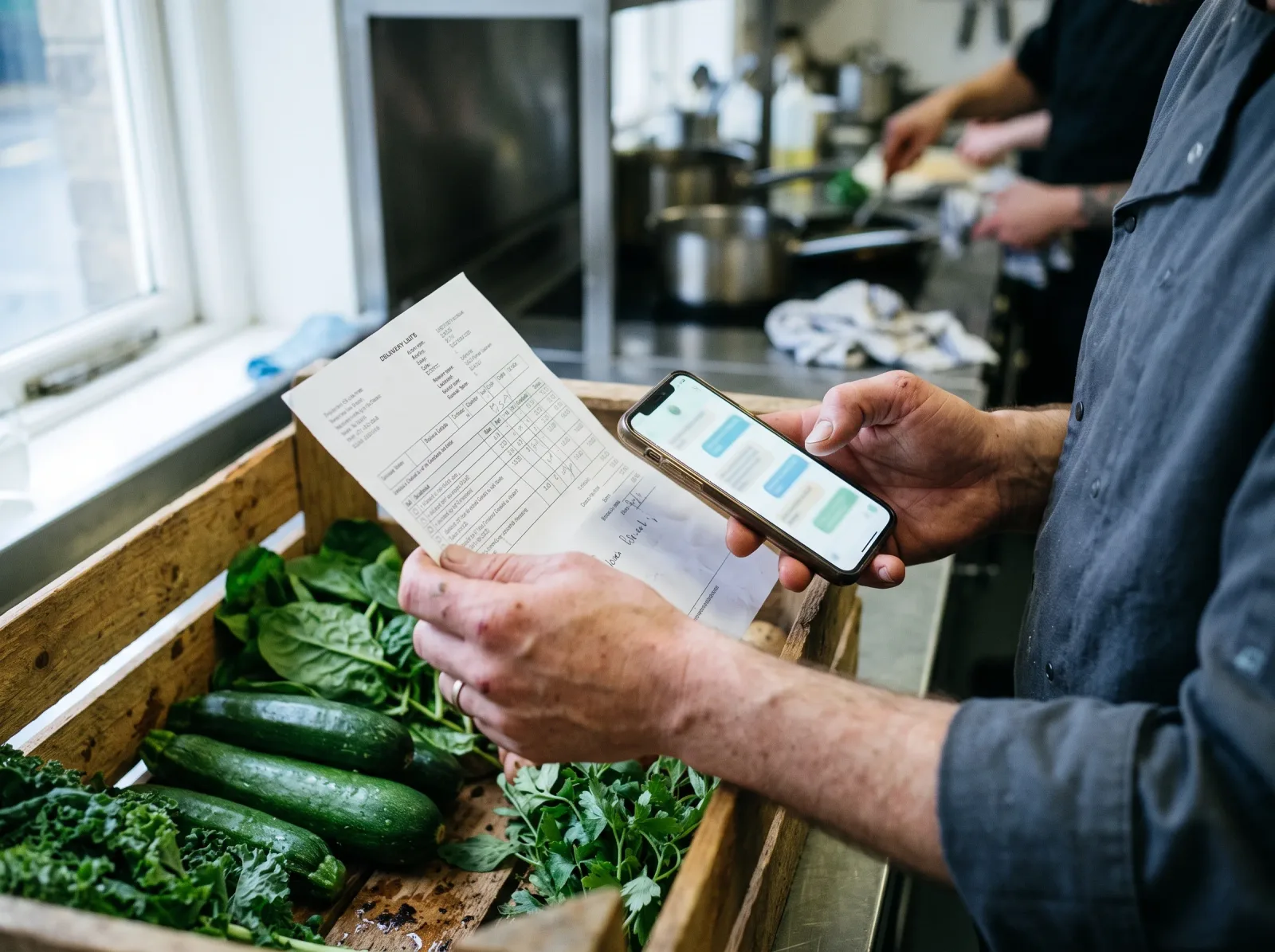
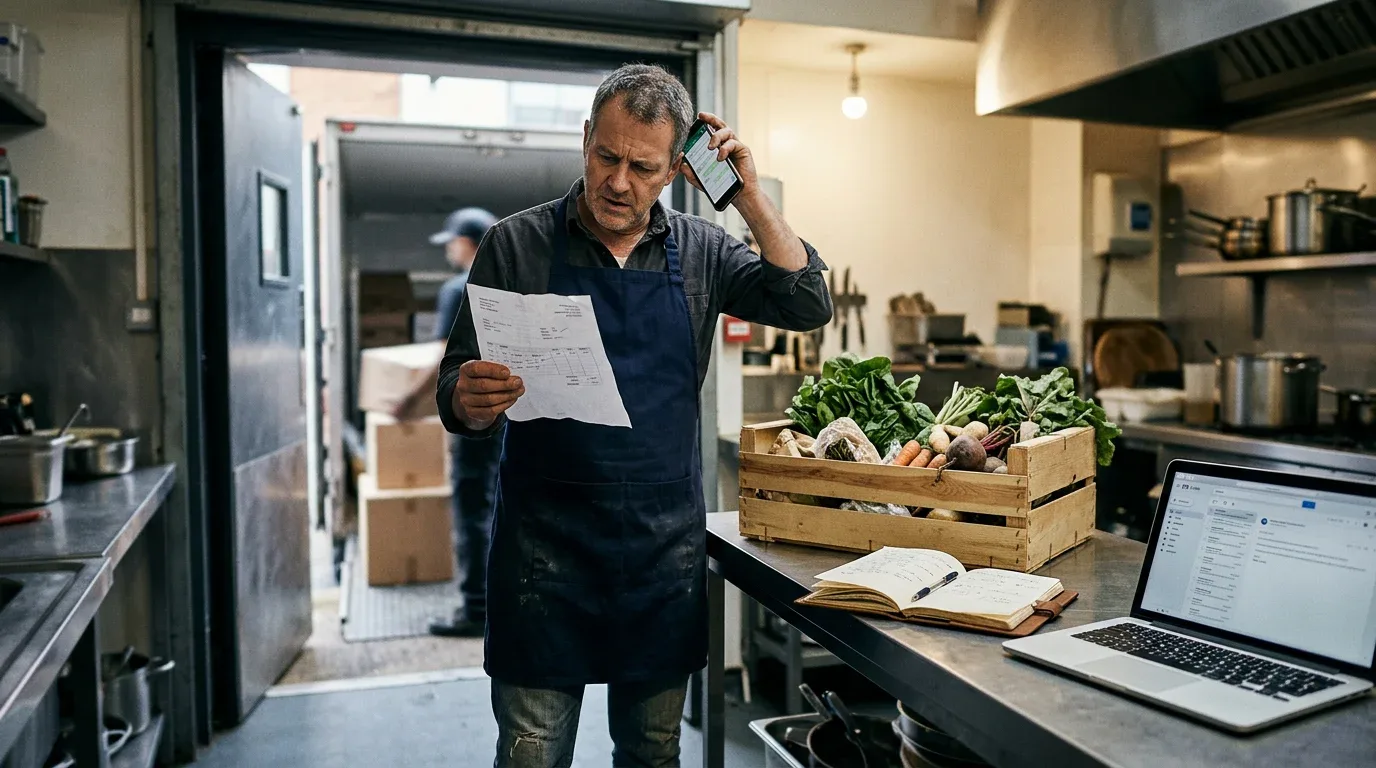
The real ordering workflow at a restaurant that orders by hand isn't disorganized. It's distributed. WhatsApp or a group text for produce, a phone call to the butcher who only picks up before eleven, a PDF over email for beverage — and none of the three channels knows what the other two did. Picture a typical night, stated plainly as an example and not a case study: Thursday, close, and the sous chef is sending three voice notes to three different suppliers while the fryers cool down.
What holds that together isn't the messages. It's what people remember. Somebody knows the produce house cuts off at four and doesn't run Mondays. Somebody knows the current seafood price list is the one that came through the chat two weeks ago, not the printed one taped inside the dry-storage door. Somebody remembers the butter was quoted at a different number than the one printed on the delivery ticket. As long as that person is on the schedule, the system holds.
The cost doesn't show up in a wrong order. It shows up at receiving, and again at the end of the month. The delivery arrives, somebody signs for it fast because the driver is waiting, and the comparison against the quoted price — if it happens at all — happens weeks later, on paper, after the product has already been used. The group chat isn't the cause of any of this. It's the workaround the job grew for itself.
Order cutoff, price list, delivery days: the three constraints your system doesn't model
Every supplier brings three rules of their own, and it's those rules — not the number of SKUs — that give restaurant ordering a shape inventory software doesn't have. The first is the order cutoff: the window inside which an order still counts for the next delivery. It isn't a time written down somewhere. It's a state that flips during the day. At four o'clock that order ships tomorrow; at six it ships the day after, and the difference gets paid for on the line during dinner service.
The second is the supplier price list, which in this business isn't a file format so much as a species. One supplier emails a PDF. One sends a spreadsheet. One sends a photo of a handwritten sheet. One sends nothing at all and tells you the numbers over the phone. A generic ordering module assumes a stable catalog with prices already loaded; your fish guy's prices move with the market, and the document carrying them changes format every time the rep changes.
The third is the delivery cadence: three times a week for one, Tuesday and Friday for another, will-call with two days' notice for a third. Taken one at a time these are trivia that anyone who has worked a kitchen handles without thinking. Taken together and multiplied by the number of suppliers you actually use, they become a calendar nobody has ever written down, living entirely in the heads of two or three people. The ordering module doesn't model that calendar because it doesn't know the calendar exists. What exists, as far as it's concerned, is a par level and a default vendor.
What a tool built for ordering does differently
Software built for ordering starts from the supplier and the calendar instead of the item catalog, and that decision propagates into every other one. There isn't one cart; there's a cart per supplier, because the real unit of work is the order that goes out to one supplier, not the combined shopping list. The order cutoff isn't a reminder either — it's a state of the system. If it has closed, you see that while you're building the order, not after you've sent it.
The supplier price list stops being an attachment and becomes live data with a history: today's price, the price the last time you ordered, and the difference between the two in front of somebody before they confirm, not at month end. Same logic behind recurring orders. A standing order isn't a template you refill from scratch every week; it's the starting point. Here's what you bought last Tuesday — change what needs changing and send it.
It's also why a tool like this is preoccupied with the phone. Nobody orders sitting at a desk at nine in the morning. Orders get placed standing up, one-handed, between services. A module designed for the back office of a management platform can afford to be dense; an ordering tool can't, because its real competition isn't other software. It's a ten-second voice note.
How to tell if the module you have is costing you something
The signals are in this week's paperwork, not in a digital-maturity questionnaire. Take the last seven days and check:
- Where is the current price list for each of your main suppliers? If the answer for even one of them is "in a chat thread" or "Danny knows it," that price isn't in any system.
- Who knows the order cutoffs by heart? If the number of people who can place an order without asking somebody is one, you have a staffing constraint dressed up as a procedure.
- How many of this week's deliveries were checked against the price you expected before somebody signed for them?
- How many of this week's orders exist only as a sent message, with no copy anywhere you could search a month from now?
- When was the last time your ordering module stopped you from making a mistake — a supplier already closed, a price that moved, a quantity off by a decimal?
The last question matters more than the other four. A tool that records orders is doing filing. A tool that stops you before the error is doing the work.
What a dedicated ordering tool won't fix
A tool built for ordering won't improve your supplier relationships, won't lower your prices by itself, and won't take the negotiation off anybody's plate. If butter is expensive because your volume is what it is, it stays expensive inside a well-built app too — with the not-small difference that now you see it while you're ordering instead of at month end.
It also has a real cost of entry, and it's worth looking at squarely before you sign anything: the item catalog and the price lists have to be loaded once, then maintained whenever a supplier or a format changes. That's work you're already doing today, scattered across a hundred small gestures that don't feel like work because nobody has ever counted them together. The question isn't whether that work exists. It's whether you'd rather it lived in a system or in your sous chef's head, on the week your sous chef is on vacation.
Keep your spending under control with mayo
Up-to-date price lists, centralized orders and prices verified on every delivery. Try it with your team.
Keep reading
Ordering From Several Suppliers: A Unified Cart Doesn't Save Time Where You Think
Writing five orders on five different channels is tedious, but that isn't where the real time goes. It goes when something doesn't add up and you have to work out what you actually ordered, from whom, and where you wrote it down. That is where a unified cart saves time: one order history instead of five places to search.